
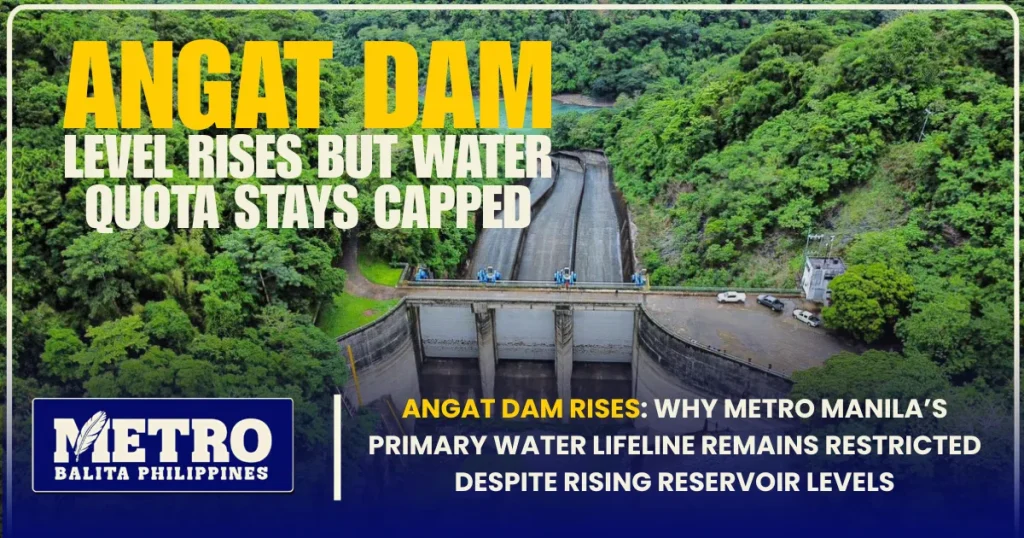
BULACAN, Philippines — At first glance, the latest hydrological data from Central Luzon offers a long-awaited breath of relief for a capital region perpetually on the brink of a water crisis. Following weeks of southwest monsoon activity and localized precipitation across the Sierra Madre mountain range, state hydrologists confirmed that surface levels at Angat Dam have finally breached the critical 180-meter minimum operating threshold.
According to official monitoring logs published by the Bulacan Provincial Disaster Risk Reduction and Management Office (PDRRMO), the water elevation recorded at the reservoir reached 181.87 meters as of 11:00 AM. The figure represents a steady 1.87-meter buffer above the absolute baseline required to maintain standard distribution operations.
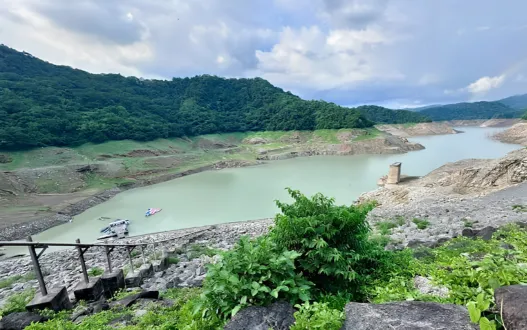
Yet, despite this physical rebound from the severe drawdown experienced earlier in the month—when water levels at Angat Dam plummeted to an alarming 155.40 meters—the national government is keeping the taps firmly controlled.
The National Water Resources Board (NWRB) confirmed that municipal raw water allocation to the Metropolitan Waterworks and Sewerage System (MWSS) will remain strictly capped at 42 cubic meters per second (CMS), backed by a minor two-CMS standby reserve. Under non-crisis conditions, the capital region draws a baseline of 52 CMS from Angat Dam to supply its domestic, commercial, and industrial grid.
This stark divergence between rising physical storage and restricted allocation highlights a complex reality: in an era of violent climate swings, getting past the minimum operating line is no longer enough to declare an emergency over.
The Strategic Math Behind the 42-CMS Allocation Cap
To understand why regulators refuse to release more water to Metro Manila despite visible hydrological gains, one must examine the long-term operational strategy governing Angat Dam. State engineers do not measure water security by immediate surface gains; they measure it against seasonal probability curves designed to withstand sudden multi-month dry spells.
NWRB Executive Director Sevillo David Jr. noted that maintaining the reduced 42-CMS output from Angat Dam through the end of August is a deliberate policy choice aimed at building structural durability. While an elevation of 181.87 meters prevents immediate mechanical failure at intake structures, it remains drastically below the ideal high water mark—or “rule curve”—of 210 to 212 meters needed to guarantee supply through the upcoming dry season.
Releasing high volumes of water the moment surface levels cross the 180-meter mark is a short-sighted strategy. If monsoon rains taper off prematurely and administrators prematurely expanded municipal discharge back to 52 CMS, the entire Metropolitan area could face a catastrophic supply collapse by the first quarter of next year.
By enforcing a conservative distribution cap now, regulators are effectively forcing urban utility systems to absorb temporary operational pressure in order to store every possible inflow drop for the future. The strategy treats the current monsoon season not as an excuse to increase consumption, but as a narrow window to build an indispensable reservoir buffer at Angat Dam.
Agricultural Sectors Hold Their Breath for Irrigation Approvals
While urban consumers adjust to reduced supply pressures, agricultural communities across Central Luzon are facing their own high-stakes countdown. The current conservation protocol at Angat Dam does not merely limit drinking water to the capital; it completely halts primary irrigation releases for thousands of hectares of farmland in Bulacan and Pampanga.
Christian Manalo, Regional Director for Central Luzon at the National Irrigation Administration (NIA), revealed that farming networks are waiting for specific storage milestones before field operations can fully recover. According to NIA guidelines, official requests for dedicated agricultural discharges from Angat Dam will only be submitted once the surface elevation reaches 185 meters.
This 185-meter threshold marks a vital operational tipping point. Downstream from the main storage complex lies the Bustos diversion system, which channels raw supply directly into vast agricultural networks. Encouraged by recent rainfall, many rice farmers across the region have already begun initial land preparation and seed planting.
Without guaranteed secondary flows from Angat Dam, these newly planted crops face high risk of failure if localized rains stall. However, state managers maintain that human domestic consumption in the capital must take absolute priority over agricultural allocation until bulk storage safely clears emergency margins.
The delayed opening of irrigation gates forces rural households to rely on expensive gasoline-powered groundwater pumps, driving up operational costs for farmers who are already struggling with rising input prices. This ongoing freeze creates a direct economic ripple effect across local food markets, demonstrating how reservoir policies at Angat Dam instantly shape market prices across the island.
The Structural Tension Between City Taps and Farming Fields
The ongoing freeze on agricultural releases underscores a fundamental structural tension embedded within the country’s water governance framework. Designed and built in the 1960s in the municipality of Norzagaray, Angat Dam was engineered as a multi-purpose infrastructure asset tasked with three primary functions:
- Domestic water supply for the expanding national capital
- Hydroelectric power generation for the Luzon grid
- Flood control and agricultural irrigation for regional farming provinces
Six decades later, rapid urban spillover has radically altered these original priorities. Metro Manila now relies on Angat Dam for nearly 90 percent of its total potable supply. As population density and commercial demand in the capital continue to surge, the margin of error for managing regional storage has virtually vanished.
During periods of hydrologic stress, agricultural allocations from Angat Dam are always the first to be curtailed. This creates a recurring economic strain on rural farming households, who bear the brunt of urban water security policies whenever seasonal rainfall falls short of projections.
Policy analysts argue that this zero-sum game between urban residents and rural agricultural producers is an inevitable consequence of outdated resource planning. When a single impoundment facility is forced to serve as both an emergency backup for megacities and an engine for agricultural productivity, friction between municipal utilities and farming cooperatives becomes guaranteed during weather anomalies.
Watershed Degradation and the Threat of Reservoir Siltation
The long-term challenge of managing bulk water reserves extends far beyond seasonal rainfall variations. Environmental scientists warn that the physical storage capacity of Angat Dam is being continuously eroded by systemic environmental degradation along the Sierra Madre mountain range.
Decades of illegal logging, forest clearing, and unchecked soil erosion have accelerated siltation across the catchment basin. As topsoil washes down from denuded forest slopes during heavy rain events, sediment accumulates along the reservoir floor, effectively reducing the actual volume of water Angat Dam can hold.
When silt fills the lower levels of a reservoir, the surface elevation reading can become deceptive. A gauge might read 180 meters, but the actual volume of usable water stored beneath that surface level is significantly lower than it was thirty years ago due to displacement caused by mud and sediment buildup over decades of operations.
Government agencies and environmental organizations have repeatedly pushed for intensified watershed protection programs around Angat Dam, including reforestation drives and strict enforcement against illegal quarrying. Protecting the upper forest canopy is now recognized as a critical civil defense priority, directly tied to the structural longevity of the nation’s primary utility assets.
Without an aggressive, sustained effort to rehabilitate the surrounding forest cover, the effective life of Angat Dam will continue to shrink. Dredging operations to clear silt are prohibitively expensive and technically complex, leaving forest restoration as the only viable long-term defense for preserving catchment capacity.
Regional Flood Control Protocols and Downstream Vulnerabilities
In addition to managing scarcity, storage administrators at Angat Dam must constantly prepare for the opposite crisis: sudden, overwhelming excess during severe typhoon events. Managing a massive inland sea demands a delicate balance between conserving water for dry months and maintaining sufficient vacant capacity to absorb catastrophic storm surges.
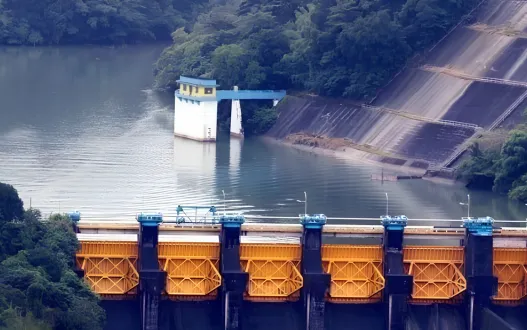
When sudden typhoons dump torrential rains into the Sierra Madre catchment, water levels at Angat Dam can rise by several meters in a matter of hours. If the reservoir is kept too full during the peak of typhoon season, operators are forced to open spillway gates on short notice to protect the dam’s structural integrity from overtopping.
Unplanned discharge operations send millions of cubic meters of water rushing downstream into the Angat River basin, submerging low-lying municipalities in Bulacan such as Hagonoy, Calumpit, and Plaridel. These downstream communities live under a constant dual threat: facing water rationing during droughts and devastating floods when storm management protocols require emergency releases from Angat Dam.
To mitigate these downstream risks, the PDRRMO works in tandem with state hydrologists to establish predictive discharge models. By releasing small, controlled volumes ahead of forecasted severe weather systems, engineers attempt to create a temporary buffer in Angat Dam without inundating farming villages along the riverbanks.
Urban Concessionaires Adapt to Reduced Raw Water Volumes
With the primary distribution quota from Angat Dam locked at 42 CMS, private water concessionaires—Maynilad Water Services, Inc. and Manila Water Company, Inc.—have been forced to alter their daily operational strategies across Metro Manila.
To prevent widespread service blackouts, utility operators are employing a combination of supply-side engineering and localized pressure management:
- Off-Peak Pressure Management: Decreasing pipe pressure during late-night hours to reduce background leakage across aging distribution networks.
- Alternative Source Optimization: Ramping up production at modular water treatment facilities drawing raw supply directly from Laguna de Bay.
- Deep Well Reactivation: Temporarily bringing groundwater wells online to supplement elevated or end-of-line residential communities.
- Non-Revenue Water (NRW) Reduction: Accelerating pipe replacement projects to recover lost volume before it leaks out of the municipal grid.
While these measures have successfully prevented full-scale utility collapse, they represent temporary operational workarounds rather than permanent solutions. Pumping groundwater from deep wells accelerates land subsidence in coastal areas, while treatment plants drawing from shallow lakes face high operational expenses due to heavy seasonal algae blooms and industrial run-off.
The Economic Consequences of Prolonged Water Conservation
The decision to maintain strict distribution caps on Angat Dam carries tangible economic consequences for both commercial industries and private consumers. Commercial establishments, such as manufacturing plants, hotels, and food processing facilities, require consistent water pressure to operate efficiently.
When municipal pressure drops due to capped releases from Angat Dam, businesses are forced to invest in private holding tanks, booster pumps, and secondary filtration systems. These capital expenditures drive up the cost of doing business in the capital region, ultimately contributing to inflation as companies pass extra infrastructure expenses onto consumers.
For low-income households in unserved or low-pressure zones, the consequences are even more severe. Many families must stay up past midnight to collect water during brief operational windows or pay inflated prices to private water delivery vendors.
Furthermore, public health experts emphasize that intermittent supply in municipal water grids increases the risk of pipe contamination. When water pressure drops to zero, negative pressure inside older distribution pipes can draw surrounding groundwater and pollutants through micro-cracks, threatening tap water safety once normal pressure is restored.
The Urgent Imperative for Infrastructure Diversification
The recurring annual drama surrounding storage elevations and allocation caps at Angat Dam points to a single, inescapable conclusion: Metro Manila’s over-reliance on a single primary water source is an unsustainable structural liability.
Urban planning experts and civil engineers have long warned that relying on one catchment system to support a metropolitan economy of over 14 million people invites systemic catastrophe. A single severe seismic event along regional fault lines or an unprecedented multi-year drought at Angat Dam could trigger an unprecedented urban crisis.
While long-delayed infrastructure projects—such as the Kaliwa Dam venture and various coastal desalination plants—are framed as necessary steps toward diversification, their progress remains slow due to regulatory hurdles, environmental concerns, and community displacement debates.
Developing secondary storage systems is no longer just an engineering goal; it is a vital imperative for national economic survival. Emerging climate realities demand a multi-tiered approach that integrates large-scale rainwater harvesting, wastewater recycling for industrial use, and coastal desalination infrastructure to relieve the pressure on Angat Dam.
Policy Reforms and the Future of National Water Security
As climate volatility continues to alter historic weather patterns, lawmakers are facing increased pressure to overhaul the country’s fragmented water governance institutions. Currently, over a dozen different government agencies handle various aspects of water policy, leading to bureaucratic delays and conflicting priorities during crisis events at Angat Dam.
Proponents of administrative reform have repeatedly called for the creation of a unified Department of Water Resources. A single executive cabinet department would streamline resource planning, consolidate regulatory oversight, and ensure that long-term infrastructure investments are executed without political interference.
Additionally, policy experts advocate for the adoption of smart grid monitoring systems across national watersheds. Utilizing real-time data analytics, satellite soil moisture mapping, and predictive climate modeling allows engineers at Angat Dam to make precise release adjustments days ahead of time, maximizing conservation while minimizing human error.
Until these institutional reforms and secondary storage complexes come fully online, state regulators have no choice but to manage existing assets with extreme caution. The 42-CMS allocation cap is not an administrative delay; it is a vital defensive posture against an uncertain climate future. For now, the capital must learn to conserve every drop, even as the waters rise at Angat Dam.
Stay updated with the latest news at Metro Balita PH.