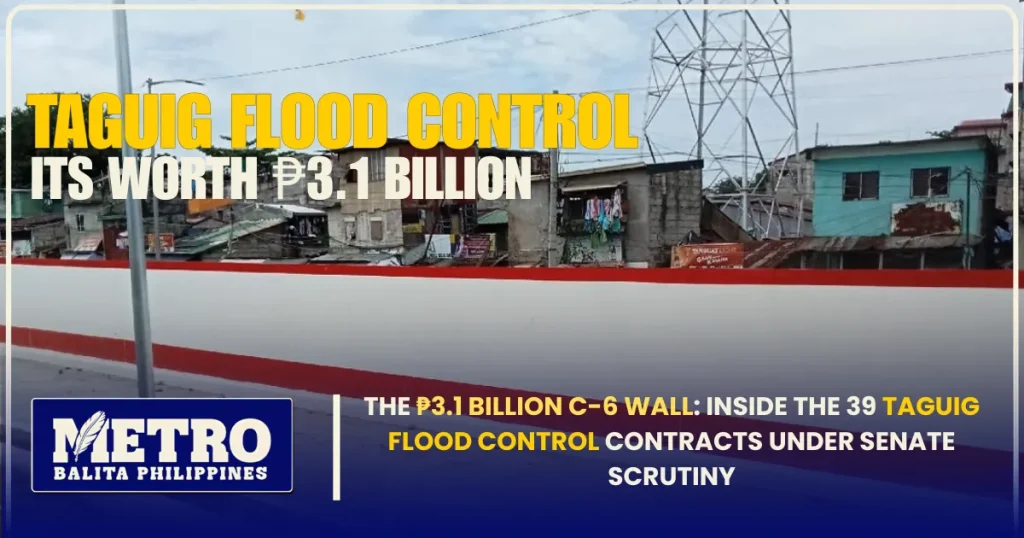
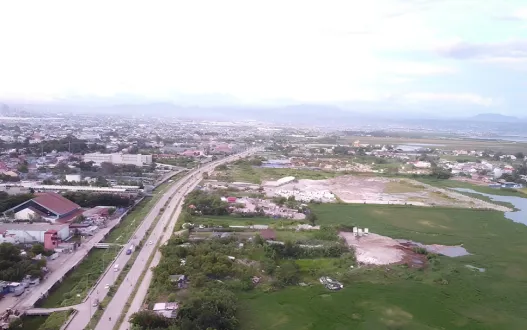
A massive infrastructure project along Metro Manila’s eastern corridor is drawing intense legislative scrutiny following revelations that what appears to be a single, continuous red-and-white embankment along the Circumferential Road 6 (C-6) Open Channel is actually composed of 39 separate Taguig flood control contracts worth a total of roughly ₱3.1 billion. An extensive review of Department of Public Works and Highways (DPWH) documents initially uncovered 30 distinct agreements linked to slope-protection and bank-improvement efforts along the arterial waterway. Further investigation expanded that figure to 39 total project entries, which together comprise the multi-billion-peso undertaking designed to fortify the local drainage system against heavy monsoon rains.
The sheer volume of individual contracts awarded along a single 6.89-kilometer stretch has triggered a much larger inquiry into public spending, procurement oversight, and document authenticity surrounding the Taguig flood control initiative. What was presented to the public as a cohesive environmental protection project is now at the center of a national debate on how public works projects are chunked, documented, and billed to national taxpayers.
Unpacking the 39 Taguig Flood Control Contracts Along C-6
The C-6 Open Channel serves as a vital drainage corridor connecting major water pathways in the eastern sector of Metro Manila, designed to channel excess flow away from residential centers toward Laguna de Bay. Over the past decade, national government agencies earmarked billions of pesos to stabilize the channel’s embankments, prevent severe soil erosion, and safeguard nearby urban centers.
According to DPWH records dating back to 2016, the Taguig flood control effort was divided into numerous small phases, sections, and sub-projects rather than being executed as a single, consolidated infrastructure endeavor. Each phase carried its own unique contract identification number, assigned budget allocation, and designated contractor. This fragmented contracting model meant that short sections of slope protection were funded through independent agreements, resulting in dozens of individual awards for contiguous stretches of concrete walling.
Among the entities involved in these public works, investigators identified a joint venture between Alpha & Omega General Contractor & Development Corp. and Elite General Contractor & Development Corp. Both firms are associated with the Discaya family, prominent figures in local public works contracting. Beyond the direct embankment walls, related public infrastructure along the channel—including two bridge structures and a specialized drainage component—were also awarded to entities tied to the same business group.
Critics argue that splitting a single continuous wall into 39 distinct contracts complicates regulatory oversight and creates administrative loopholes. While multi-phase implementation is common in large civil works, the rapid accumulation of independent Taguig flood control agreements along the same small stretch of road has raised eyebrows among legislative auditors.
The ₱450 Million Per Kilometer Price Tag and Physical Ground Realities
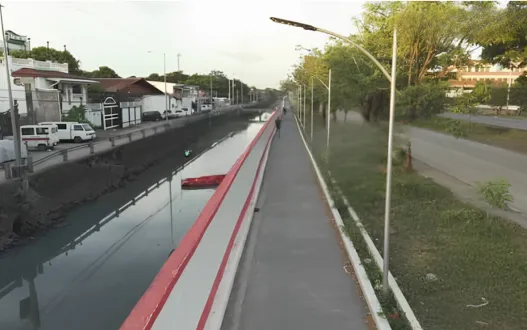
In a 2024 official media release, the DPWH highlighted the C-6 embankment initiative as a centerpiece of Metro Manila’s regional disaster mitigation strategy. Official agency documentation outlined a total project scope spanning 6.89 kilometers, intended to arrest soil erosion, manage surface stormwater runoff, and reinforce channel stability. The overall development plan also incorporated community site enhancements, including elevated walkways and a designated jogging path running parallel to the roadway.
When calculating the total expenditure against the physical span, the identified ₱3.1-billion figure translates to an average cost of approximately ₱450 million per kilometer for the Taguig flood control works. This unit cost has become a focal point of intense controversy among civil engineering observers and public finance analysts.
Physical site inspections along the C-6 corridor reveal a visible, red-and-white painted concrete wall standing less than two meters above ground level, with a structural thickness measuring approximately six to seven inches. Archives of construction photographs indicate that ground crews performed excavation work, foundation layering, and base stabilization during early build phases.
However, civil engineering experts note that surface observations alone cannot fully account for subsurface expenditures. Determining the structural validity and true financial value of underground foundations, sub-grade piling, sheet piles, and specialized drainage systems requires detailed cross-referencing against the project’s official Program of Works, approved technical plans, and billing measurement sheets. Without transparent technical audits, evaluating whether the ₱450 million per kilometer cost is justified remains difficult for the public.
Adding to the controversy, local residents living adjacent to the C-6 Open Channel expressed surprise at the massive financial allocation. In field interviews, long-time community members observed that the open channel rarely overflowed its banks even before the multi-billion-peso Taguig flood control slope-protection walls were constructed. The DPWH maintained that the structural interventions were essential engineering steps to protect the structural integrity of the bypass road, mitigate long-term soil movement, and prevent catastrophic channel failure during extreme weather events.
Questions Raised Over Reused Project Documentation Photos
Beyond the high per-kilometer expenditure, official audit records reveal alarming irregularities in the administrative documentation submitted for the Taguig flood control projects. A comparative analysis of project completion filings showed multiple instances where identical photographs were attached to entirely separate contract files.
In 2022, records submitted for Phase 2 and Phase 3 of the C-6 bank protection projects contained identical progress and final completion photographs. Each of these contracts carried a price tag of nearly ₱90 million, yet both relied on the same visual proof to demonstrate physical completion to government monitors.
A matching pattern surfaced in the 2024 documentation filings for Phase 3 and Phase 4 of the C-6 slope-protection series. Phase 3 represented a public outlay exceeding ₱141 million, while Phase 4 was billed at over ₱94 million. Despite being awarded to separate contracting firms, the official progress archives contained duplicate visual entries.
Similar documentation anomalies were detected in contract records for Phase 7 and Phase 8. Awarded to Topnotch Catalyst Builders and Beam Team Developer Specialist respectively at roughly ₱94.5 million each, the submitted completion images appeared to be captured from identical camera angles and locations, despite belonging to separate contract submissions.
While reused imagery does not directly establish that physical works were omitted, it represents a severe breakdown in standardized monitoring protocols required for public funding releases. In the context of the Taguig flood control developments, these duplicate records have fueled allegations of systemic negligence during final project acceptance.
DPWH Quality Assurance Team and Senate Inquiries Highlight Oversight Gaps
The discovery of duplicate photographs in the Taguig flood control records is not merely an external observation made by investigative reporters. Internal government documents disclose that the DPWH Quality Assurance Team previously identified identical visual records during internal reviews submitted directly to the office of Senator Panfilo Lacson.
The internal QA findings explicitly flagged matching photographic submissions across multiple final billing documents:
- Photos attached to the Final Billing for Contract ID No. 22OB0152 were identified as exact duplicates of those submitted under Contract ID No. 22OB0153.
- Final billing entries for Contract ID No. 22OB0153 contained identical images previously used to justify payments for Contract ID No. 22OB0151.
- Documentation attached to Contract ID No. 22OB0151 matched files submitted for Contract ID No. 22OB0153.
Crucially, these findings pertained directly to official final billing documentation—the administrative records required to release final treasury payments—rather than general public previews on transparency web portals.
Addressing these findings, Senator Panfilo Lacson criticized the procedural routine during public statements, characterizing the repetitive documentation practices as lazy and suspect. Lacson pointed out that using identical photos year after year to claim government disbursements creates serious suspicion regarding whether new physical accomplishments actually took place under each new Taguig flood control contract.
Lacson emphasized that systematically reusing older images to validate new financial claims severely undermines public trust. He noted that such practices raise legitimate concerns over whether portions of the work represent duplicate billings for pre-existing structures rather than newly completed engineering achievements.
Official Responses and the Broader Debate Over Taguig Flood Control Infrastructure
As legislative inquiries broaden to investigate national infrastructure spending, political figures have taken sharply contrasting positions regarding the Taguig flood control controversy.
Senator Alan Peter Cayetano defended the legitimacy of public works initiatives in the area, firmly rejecting allegations of phantom or “ghost” construction projects within his political stronghold. Cayetano argued that criticisms directed at the Taguig flood control undertakings were grounded in unverified hearsay, asserting that physical structures exist along the C-6 corridor and actively function to stabilize the shoreline.
Cayetano insisted that political discourse should not obscure the tangible infrastructure built along the C-6 channel, inviting reviewers to physically inspect the length of the road. However, critics counter that the presence of a physical wall does not automatically resolve questions regarding contract splitting, inflated pricing, or duplicated documentation across different financial disbursements.
For their part, independent engineering authorities emphasize that verifying full contract compliance requires an exhaustive technical audit. Independent assessors must evaluate subsurface groundwork, concrete compressive strength, sheet pile depth, and volume verification against the original engineering drawings to confirm whether the government received full value for its ₱3.1 billion investment.
Technical Analysis of Multi-Phase Contracting Mechanics
To understand how the Taguig flood control initiative accumulated 39 individual contracts, it is necessary to examine the administrative mechanics of public works budgeting in urban corridors. Public infrastructure allocations in the Philippines are often distributed across annual General Appropriations Acts (GAA), leading regional district engineering offices to tranche large-scale projects into annual budget cycles.
When a project like the C-6 embankment is fragmented into separate annual items, each section undergoes an independent bidding process. In theory, this allows multiple contractors to bid on different segments, encouraging competitive pricing. In practice, however, critics point out that it creates severe monitoring vulnerabilities. When short, adjacent segments of a single wall are awarded across multiple years to interrelated corporate entities, tracking where one contract ends and another begins becomes an administrative challenge.
In the case of the Taguig flood control works along C-6, this tranche-based structure meant that individual contracts ranging from ₱90 million to ₱141 million were processed side by side. Oversight bodies now face the task of physically mapping each of the 39 contract scopes against the physical 6.89-kilometer stretch to determine if any overlapping boundaries or double-counted linear meters occurred during project execution.
Furthermore, civil society groups emphasize that the sheer technical complexity of subsurface sheet piling and embankment stabilization makes post-hoc audits difficult without destructive testing. Because a large portion of flood control investment is buried underground in the form of foundation piles and soil reinforcement, verifying whether a contractor installed the exact depth and quality of materials specified in a ₱94-million contract requires specialized equipment and deep core sampling.
Institutional Implications for Future Urban Drainage Infrastructure
The controversy surrounding the C-6 Open Channel highlights broader systemic issues in how urban drainage and riverbank protection projects are managed across Metro Manila. As rapid urbanization and climate-induced rain events increase flood risks across low-lying areas, public demand for effective infrastructure has driven unprecedented budget allocations toward flood mitigation.
However, legal experts and public governance analysts stress that high budget allocations must be matched by equal rigor in transparency and field verification. The repetition of progress photos across separate Taguig flood control billing files underscores a critical weakness in traditional paper-based reporting systems, where site engineers and inspectors may sign off on completion documentation without rigorous cross-referencing against past filings.
To prevent similar vulnerabilities in future civil works, urban planners and policy experts advocate for the mandatory adoption of modern digital verification technologies. Recommendations include integrating real-time geographic information systems (GIS), mandatory drone-based aerial mapping for all linear infrastructure, and public-facing databases containing unedited, time-stamped inspection imagery linked directly to billing disbursements.
As Senate committees and independent investigative bodies continue their examination of the 39 Taguig flood control contracts worth ₱3.1 billion, the outcome of this inquiry could set an important precedent for public works governance in the Philippines. Whether through policy reform, stricter procurement rules, or legal proceedings, addressing the documentation lapses and contracting structures along the C-6 channel remains essential to restoring public confidence in national infrastructure spending.
Stay updated with the latest news at Metro Balita PH.