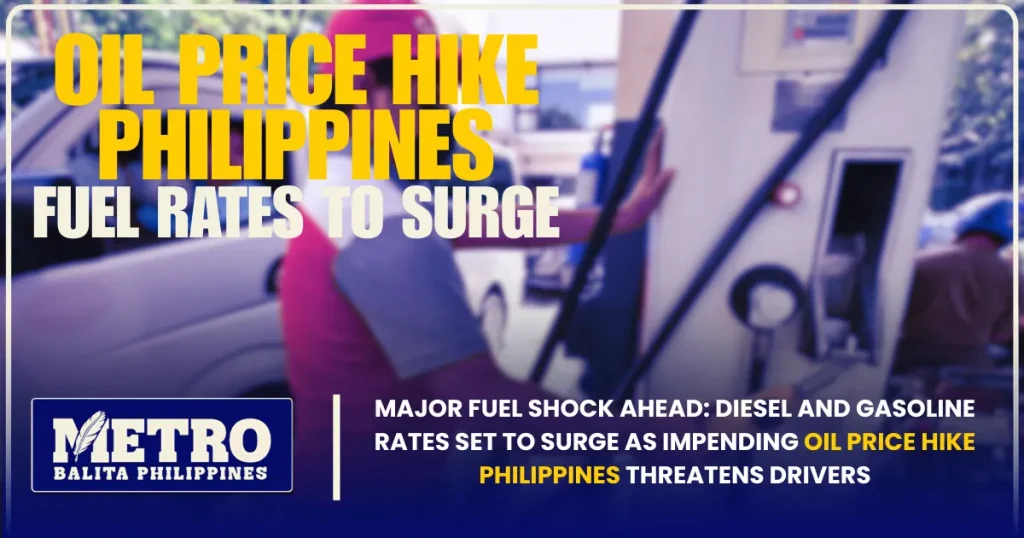
MANILA, Philippines — Filipino motorists, public utility drivers, commercial haulers, and logistics operators across the archipelago are bracing for another heavy financial blow at the pumps next week as energy market projections indicate a massive upward price adjustment in domestic petroleum products. Latest trading data from the global oil market reveals that retail pump prices for both diesel and gasoline are expected to jump significantly, driven by escalating volatility in international crude benchmarks, severe regional supply tightness, and ongoing geopolitical friction in critical maritime shipping lanes. The incoming oil price hike philippines fmotorists face will mark one of the steepest single-week price increases in recent months, threatening to disrupt household budgets and transport operations nationwide.
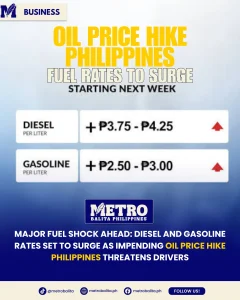
According to industry sources tracking four-day trading results from the Mean of Platts Singapore (MOPS) alongside foreign exchange movements, domestic consumers are facing a substantial oil price hike philippines consumers must navigate starting Tuesday morning. The projected figures show that diesel prices could go up by ₱3.75 to ₱4.25 per liter, while gasoline prices are anticipated to climb by ₱2.50 to ₱3.00 per liter.
If these estimates are fully realized during the final Friday calculations, this price adjustment will stand as a major financial burden for the entire Philippine transport sector. The looming oil price hike philippines drivers are preparing for threatens to instantly reverse several weeks of relative market stability, dealing a severe economic blow to public utility vehicle drivers, delivery riders, commercial fleet managers, and ordinary commuters alike.
Breakdown of Expected Fuel Increases for Next Week
Based on estimates derived from trading activities between August 10 and August 13, local oil companies are projecting the following price adjustments at retail stations nationwide:
- Diesel: Increase of ₱3.75 to ₱4.25 per liter
- Gasoline: Increase of ₱2.50 to ₱3.00 per liter
Because fuel expenses represent the single largest daily operational cost for the domestic transportation sector, economic analysts warn that a sudden oil price hike philippines commuters experience will inevitably ripple through the broader macroeconomy. Elevated transportation costs directly push up the price of agricultural produce, manufactured goods, construction materials, and baseline services across Metro Manila and surrounding provincial urban centers. Every major oil price hike philippines consumers absorb tends to trigger secondary price increases in basic market commodities, compounding inflation concerns for millions of households.
Global Factors Triggering the Massive Oil Price Hike Philippines
The incoming surge in retail fuel prices is not an isolated local event, but rather a direct consequence of shifting global energy market dynamics. Industry experts attribute the sudden oil price hike philippines fuel distributors must process to a combination of geopolitical tensions, supply bottlenecking, and continuous inventory drawdowns in major refining centers.
Stalled Negotiations and the Strait of Hormuz Crisis
A primary catalyst driving international petroleum benchmarks higher is the rapid breakdown of optimism surrounding diplomatic efforts in the Middle East. Earlier market hopes for a peace agreement and the near-term restoration of normal maritime traffic through the Strait of Hormuz have faded significantly. The Strait of Hormuz serves as one of the most vital oil transit chokepoints in the world, handling a massive portion of global sea-borne crude shipments.
Global market participants have become increasingly skeptical as diplomatic talks hit an impasse. Discussions have been complicated by competing demands for financial compensation stemming from the ongoing five-month regional conflict. As the prospect of a swift resolution diminishes, risk premiums on international crude shipping remain high, further fueling the oil price hike philippines importers have to absorb in their purchasing costs.
Tight Global Crude Supplies and Black Sea Constraints
In addition to the uncertainties in the Middle East Gulf, global raw crude availability remains severely constrained. Reduced crude oil flows from Middle Eastern producers have been compounded by lower export volumes coming out of the Black Sea region. Furthermore, persistent market anxiety over international sanctions and potential supply disruptions continues to keep global crude inventory balances tight, contributing directly to the oil price hike philippines market analysts are tracking.
Rapid Depletion of Refined Product Inventories
The price volatility is even more pronounced in refined fuel markets compared to raw crude. Finished product inventories, such as automotive diesel and motor gasoline, have experienced sharp drawdowns across major trading hubs. Part of this inventory drawdown is due to refinery output disruptions and scheduled maintenance overhauls, which have constrained total refined output.
For diesel, ongoing supply risks in the Middle East and restricted Russian petroleum exports continue to provide strong upward support for prices. For gasoline, strong seasonal demand signals across the Asia-Pacific region are providing additional price support, even as uncertainty looms over export volume quotas coming from Chinese refineries. These refined product shortages make the upcoming oil price hike philippines motorists face particularly steep for commercial diesel users.
Market Dynamics That Prevented Even Higher Increases
Despite the steep price jump expected next week, market analysts note that a couple of international economic factors helped prevent an even larger spike in benchmark trading prices.
During midweek trading, economic reports revealed signals of weakening global demand in major consuming nations, paired with an unexpected inventory build in United States commercial crude reserves. These bearish market indicators applied downward pressure on crude contracts, effectively capping what could have been an even more destructive oil price hike philippines petroleum companies would have passed on to retail pumps.
How Domestic Fuel Price Adjustments Work
Under standard practices followed by the Philippine oil industry, domestic oil companies do not adjust retail prices on a daily basis. Instead, companies assess the entire five-day weekly average of MOPS trading along with foreign exchange movements before finalizing their numbers.
The weekly cycle follows a predictable timetable across the country:
- Trading Period Assessment: Industry analysts evaluate Platts trading prices and foreign exchange rates from Monday through Friday.
- Monday Announcements: Oil companies formally issue their official price adjustment advisories every Monday morning.
- Tuesday Implementation: The updated retail pump rates take effect nationwide every Tuesday morning, usually starting at 6:00 AM.
Because the projected increases are substantial, vehicle owners and fleet managers are strongly encouraged to gas up before Tuesday to lock in current retail rates. Taking action before the official oil price hike philippines implementation allows drivers to secure significant short-term savings on their fuel expenses.
Heavy Economic Toll on Transport Workers and Small Businesses
The steep timing of this upcoming fuel price surge presents serious operational challenges for low-income transport workers, small business owners, and logistics enterprises. Jeepney, bus, taxi, and motorcycle delivery drivers operate on tight daily margins where fuel represents their single largest variable expense.
When a sudden oil price hike philippines drivers experience takes effect, the immediate burden falls straight on the daily take-home pay of transport workers. Since fare structures are fixed and regulated by government authorities, drivers cannot instantly adjust their fares to compensate for rising operational costs, forcing them to absorb the higher pump prices directly out of their personal family earnings.
Logistics operators, freight handlers, and agricultural distributors face similar cost pressure. Commercial trucking fleets rely heavily on diesel fuel to transport food, construction supplies, and consumer goods across major island highways. Persistent increases in diesel rates ultimately lead to elevated freight charges, which are eventually passed down to everyday consumers following a nationwide oil price hike philippines event.
Small business owners who run provincial cargo services, cold storage units powered by diesel generators, and mobile retail units must also reconfigure their operating budgets. When fuel prices jump by four pesos in a single week, small enterprises often see their profit margins wiped out completely unless they adjust product pricing, further contributing to inflationary pressure across rural and urban markets alike.
Practical Fuel-Saving Strategies for Motorists
To soften the impact of the upcoming fuel increase, vehicle owners and commercial fleet drivers can adopt several practical fuel management techniques:
Refuel Before the Tuesday Deadline
The most immediate way to save money is to fill up your gas tank fully before retail gas stations update their pumps on Tuesday morning. Securing current rates before a ₱4-per-liter increase saves a significant amount on a full tank, offering immediate financial relief.
Practice Fuel-Efficient Driving Habits
Smooth driving behavior directly reduces fuel consumption. Avoid sudden accelerations, maintain steady driving speeds, and anticipate traffic flow to minimize unnecessary braking. Excessive idling while parked also wastes valuable fuel, so turning off the engine during extended stops can save a substantial amount of fuel over time.
Maintain Proper Vehicle Maintenance and Tire Pressure
Driving on underinflated tires increases rolling resistance, which forces the vehicle’s engine to work harder and consume more fuel. Keeping vehicle tires inflated to the manufacturer’s recommended pressure can improve overall fuel efficiency by up to three percent. Regular engine maintenance, such as replacing dirty air filters and using recommended motor oils, also keeps fuel consumption at optimal levels.
Optimize Travel Routes and Consolidate Trips
Combine multiple daily errands into a single structured trip to reduce overall vehicle mileage. Planning travel routes to bypass high-congestion traffic zones during peak hours helps avoid engine idling in heavy stop-and-go traffic, conserving fuel throughout the week.
Maximize Fuel Rewards and Loyalty Discounts
Many fuel companies and financial institutions offer customer loyalty programs, cash-back credit cards, and promotional discount vouchers. Utilizing these rewards at participating gas stations can provide steady per-liter discounts, helping cushion the effect of a major oil price hike philippines motorists face.
Long-Term Outlook for Local Petroleum Prices
Market analysts remain cautious regarding fuel price stability in the coming months. Because the Philippines relies almost entirely on imported refined petroleum products to meet its energy needs, local pump prices will stay closely tied to international benchmark fluctuations and foreign currency exchange rates.
If diplomatic efforts successfully ease maritime security risks through the Strait of Hormuz and regional refinery outputs stabilize, international fuel benchmarks could see relief. However, if geopolitical volatility persists and global inventory drawdowns continue, Philippine motorists should prepare for continued price adjustments in the weeks ahead.
All eyes will be on local fuel companies on Monday when final price announcements confirm the exact figures taking effect on Tuesday morning. Consumers and transport operators are strongly advised to prepare their budgets accordingly as another severe oil price hike philippines fuel buyers encounter arrives at retail pumps nationwide.
Get the latest news and updates right here on Metro Balita PH.