
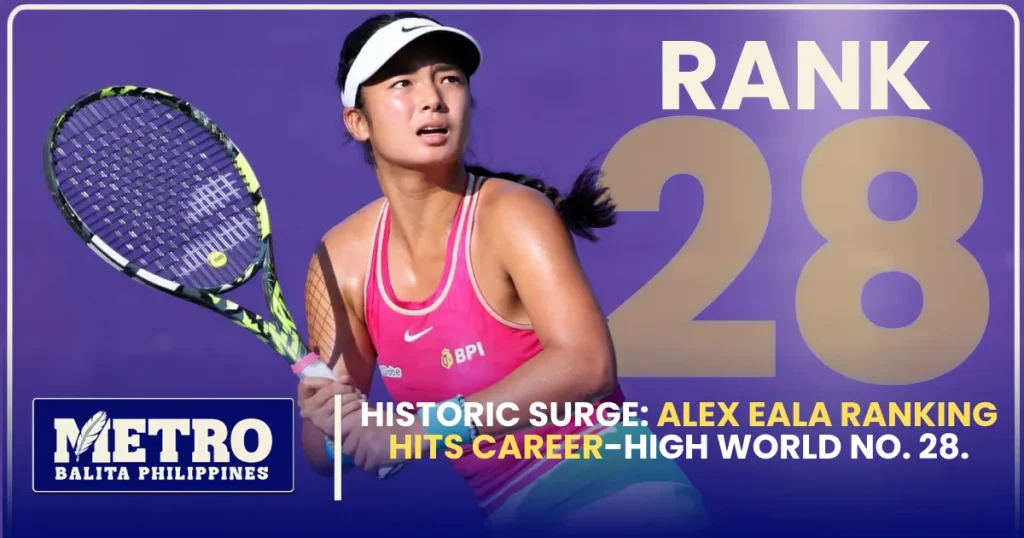
The landscape of Philippine tennis has officially shifted, marking an unprecedented milestone for Southeast Asian sports. Filipina tennis sensation Alexandra Alex eala ranking has officially breached the elite tier of women’s professional tennis, achieving a milestone that will completely rewrite local history books. Following a stunning, narrative-defying run on the hallowed grass courts of London, the updated Alex eala ranking has reached a spectacular, career-best World No. 28 in the Women’s Tennis Association (WTA) singles ladder. The official update, published by the WTA tour management on Monday morning, confirms Eala’s ascent of four strategic spots up from her previous position of World No. 32.
This historic surge is the direct result of her groundbreaking performance at the 2026 Wimbledon Championships, where she captured the attention of the global tennis community by marching all the way to the fourth round—marking her most successful Grand Slam main draw campaign to date. For perspective, breaking into the world’s top 30 is a feat rarely achieved by athletes from developing tennis nations, solidifying the 21-year-old Rafael Nadal Academy product not just as a rising star, but as an established powerhouse on the global tour. The sporting world is now forced to look at Philippine tennis through an entirely new lens as Eala continues her meteoric rise on the international circuit.
The Masterclass in London: How Eala Secured Her Top 30 Status
Eala’s journey through the 2026 Wimbledon draw was nothing short of cinematic. Arriving at the All England Lawn Tennis and Croquet Club as a dangerous floater, she displayed a profound evolution in her tactical maturity and physical conditioning. While grass has historically been a challenging surface for players baseline-trained on clay or hard courts, Eala adapted her movement and abbreviated her clean, left-handed groundstrokes to devastating effect. In the opening rounds, she showcased a level of poise that bypassed her age, systematically dismantling lower-ranked opponents who struggled to counter her deep, punishing baseline returns and improved first-serve metrics.
The absolute pinnacle of her London breakthrough came during a dramatic third-round clash that will likely be remembered as a turning point in her professional career. Facing World No. 1 and multi-time Grand Slam champion Iga Swiatek of Poland, Eala played fearless, high-octane tennis. She neutralized Swiatek’s heavy topspin with aggressive, early-taken returns, ultimately pulling off a staggering upset that reverberated across the sporting world.
Though her fairytale run was eventually halted in the fourth round by Italy’s resilient veteran Jasmine Paolini, the massive haul of ranking points earned from reaching the second week of a major provided the exact fuel needed to propel the Alex eala ranking to its current historic heights. The performance proved that her placement among the world’s elite is not a temporary fluke but a reflection of elite-level execution against the absolute best in the sport.
Analyzing the Strategic and Analytical Impact of the New Alex Eala Ranking
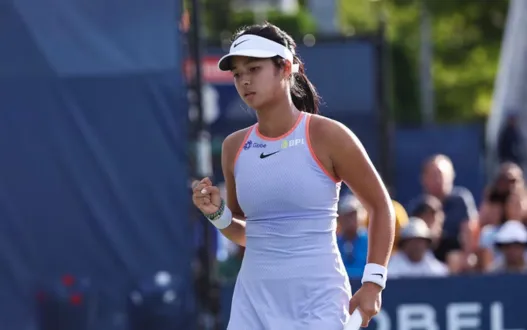
From an analytical standpoint, Alex eala ranking at World No. 28 completely alters the trajectory of Eala’s immediate future on the WTA Tour. In professional tennis, a player’s standing dictates everything from financial stability to tournament entry logistics. By securing a spot inside the top 30, the Alex eala ranking ensures that she will receive automatic entry into the main draws of all upcoming WTA 1000 and WTA 500 events without having to endure the grueling, multi-round qualifying brackets. This eliminates the physical exhaustion of playing qualifiers, allowing her to preserve peak energy for the main stages where the highest point yields reside.
More importantly, this position practically guarantees that Eala will be a seeded player at the upcoming US Open later this year. Being seeded at a Grand Slam is an immense structural advantage, as it protects a player from facing any other top-ranked competitors during the first two rounds of the tournament, significantly smoothening the path toward the second week and protecting her accumulated points. The financial implications are equally staggering; higher seeds draw greater primetime television coverage, which naturally translates to lucrative international sponsorship opportunities and stronger commercial leverage for her management team.
From Prodigy to Powerhouse: The Steady Ascent of a Phenom
Eala’s rise to World No. 28 is the culmination of a meticulously managed transition from a junior prodigy into a senior tour force. Long before the recent Alex eala ranking update shook up the WTA standings, she was already carrying the hopes of a nation. As a junior, she captured three Grand Slam titles—the 2020 Australian Open girls’ doubles, the 2021 French Open girls’ doubles, and her crowning individual achievement, the 2022 US Open girls’ singles championship. These early accolades gave the world a glimpse of her raw potential, but the transition to the senior tour is a notoriously difficult bridge to cross.
Transitioning to the grueling senior circuit can often break even the most decorated junior champions. It requires a massive step up in raw physical power, mental resilience, and the financial backing to sustain a global traveling team. Backed by the Manny V. Pangilinan Sports Foundation (MVPSF) and trained under the elite technical guidance of the Rafael Nadal Academy in Mallorca, Spain, Eala spent the last few seasons grinding through lower-tier ITF events, gradually building up her physical frame and tactical nuance. Every incremental rise in the Alex eala ranking over the last twenty-four months has been earned through back-to-back matches in sweltering conditions, far away from the glamour of center courts. Her coaches have intentionally focused on long-term physical durability, ensuring that her shoulder and core strength can withstand the heavy ball speeds characteristic of modern women’s tennis.
Breaking Down the Numbers: The WTA Points System and Upward Mobility
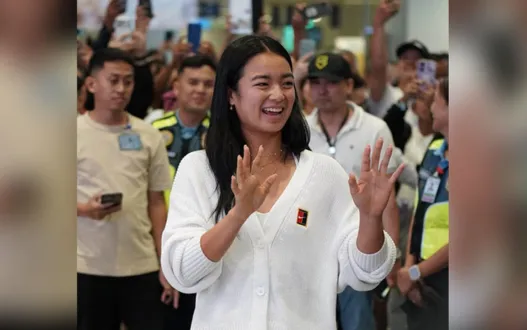
To understand how significant this jump is, one must look at the mechanics of the WTA points system. Tennis rankings operate on a rolling 52-week defense cycle. Players must constantly match or exceed their performance from the previous year to prevent their point totals from eroding. Eala’s deep run into the second week of Wimbledon injected a massive, un-diluted block of points into her profile, forcing a dramatic leap past several seasoned veterans who failed to defend their summer point allocations.
This upward mobility creates a snowball effect for her developmental timeline. When a player breaks into the top 30, they gain access to specialized tournament scheduling. Instead of crisscrossing the globe to chase low-tier points in minor tournaments, Eala can now curate a highly optimized calendar focused exclusively on premier events. This minimizes travel fatigue, reduces the risk of chronic sports injuries, and allows her coaching staff to implement extended training blocks designed to add new dimensions to her game, such as a more aggressive net-approaching strategy and variance in her slice serves.
What Lies Ahead: The Hard Court Season and the Road to the Top 20
With the grass-court season officially in the rearview mirror, Eala and her coaching staff are shifting their focus to the rapid hard-court swing in North America. This portion of the calendar historically suits Eala’s classic style, which relies heavily on deep, punishing groundstrokes from the baseline and an elite ability to redirect pace. The hard courts of the US Open series reward aggressive ball-striking, a core tenet of the training philosophy instilled in her during her formative years in Spain.
As the tennis world moves toward the hard courts, maintaining the current momentum will be critical. If she can preserve her physical health and replicate the aggressive, frontline tennis she displayed against Swiatek, tennis analysts widely project that the Alex eala ranking could realistically challenge the top 20 before the calendar year concludes. The gap in points between World No. 28 and World No. 20 is surprisingly narrow, meaning a single deep run at a WTA 1000 event in Toronto or Cincinnati could provide the necessary mathematical push to break another historic barrier.
The Philippines, a nation traditionally consumed by basketball and boxing, now stands firmly united behind a tennis superstar. Alexandra Eala’s ascent to World No. 28 is a loud declaration that Filipino athletes can not only step onto the most prestigious lawns of international tennis but can walk off them victorious against the absolute best in the world. As the hard-court season beckons, fans and analysts alike will be watching closely to see how far this historic surge can take her.
Official WTA Ranking Snapshot
- Current WTA Singles Position: World No. 28 (Career High)
- Previous WTA Singles Position: World No. 32
- Movement Metric: +4 positions climbed
- Primary Point Source: Wimbledon 2026 Round of 16 placement
- Signature Victory: Defeated World No. 1 Iga Swiatek (6-4, 3-6, 6-4)
Historical Milestones of Alexandra Eala
- 2020: Becomes the first Filipina to win a Grand Slam junior match in decades, capturing the Australian Open girls’ doubles title.
- 2021: Secures the French Open girls’ doubles crown, proving versatility across vastly different playing surfaces.
- 2022: Captures the historic US Open girls’ singles championship, cementing her status as the world’s premier junior prospect.
- 2024-2025: Transitions fully to the WTA senior tour, capturing multiple ITF singles titles while consistently climbing the global ladder.
- 2026: Breaks into the WTA elite top 30 following a historic fourth-round appearance on the grass courts of Wimbledon.
Conclusion: A New Era for Philippine Tennis
Ultimately, Alex eala ranking to World No. 28 represents far more than just individual success on a computer-generated spreadsheet. It signals a paradigm shift for a country whose sporting identity has traditionally been dominated by basketball, boxing, and weightlifting.
For decades, world-class tennis infrastructure and elite-level global success seemed out of reach for Filipino athletes, who often struggled to find the sustained corporate sponsorship, international coaching networks, and specialized facilities required to match European and American athletic standards. Eala has systematically shattered that glass ceiling, proving that with the right combination of structural support, raw talent, and tireless work ethic, a Southeast Asian player can stand toe-to-toe with the titans of the tour.
For more news and updates, visit Metro Balita Ph.