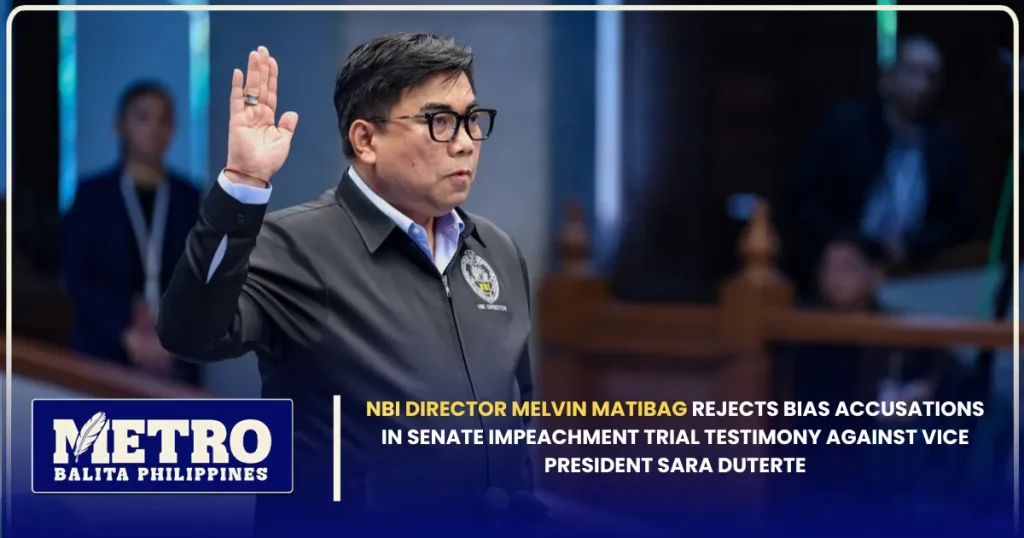
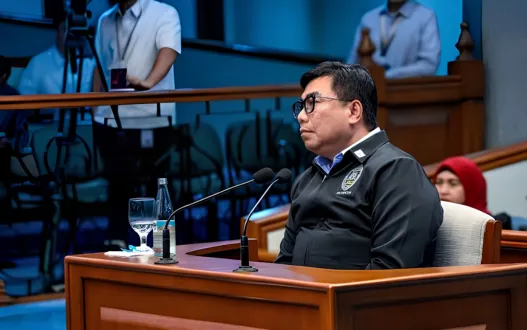
MANILA, Philippines — Standing firm under intense political scrutiny during the ongoing Senate impeachment proceedings, NBI Director Melvin Matibag strongly rejected allegations of partisan bias on Friday, July 24, 2026. Addressing public criticism and panel inquiries surrounding his recent testimony before the Senate impeachment court, NBI Director Melvin Matibag insisted that his role as the head of the country’s premier law enforcement investigative agency obligates him to present verified facts, uphold public order, and adhere strictly to institutional mandates.
The high-stakes political conflict centers on Article IV of the Articles of Impeachment, which accuses Vice President Sara Duterte of making grave threats against President Ferdinand “Bongbong” Marcos Jr., First Lady Liza Araneta-Marcos, and former House Speaker Martin Romualdez. As a key witness called by the prosecution panel to testify on national security risks and law enforcement protocols, NBI Director Melvin Matibag faced sharp pushback from defense lawyers and sympathetic lawmakers who characterized the agency’s investigative findings as one-sided and politically motivated.
“Hindi po, you have to tell the truth. We seek justice. Wala po tayong hinahanap dito. We are guided by justice, by evidence, the rule of law, procedure. At the end of the day, from law enforcement, we want order,” NBI Director Melvin Matibag stated directly, addressing lingering concerns regarding his neutrality during a press briefing following his court appearance.
NBI Director Melvin Matibag Clarifies Rules on Evidence and Custody of Official Records
Throughout the week’s trial sessions, defense counsels raised repeated technical objections regarding the admissibility of the evidence presented by the prosecution. Opponents argued that much of the testimony submitted by law enforcement officers amounted to mere hearsay because the testifying officials were not personally present during every single underlying event mentioned in the investigative dockets.
Responding directly to these legal challenges, NBI Director Melvin Matibag dismantled the hearsay arguments by pointing to fundamental rules of procedure that govern public officers and official government repositories. He emphasized that his position as agency chief brings his testimony directly under established statutory exceptions regarding official state documentation.
“It’s being alleged na hearsay. But under the rules, this is an exception to the hearsay rule. Bakit? Because I am now the custodian of the records na naiwan noon. Those are official records and I am testifying based on the records,” NBI Director Melvin Matibag explained to reporters and court observers.
By highlighting his formal capacity as the chief custodian of national records, NBI Director Melvin Matibag underscored that his statements were grounded in documented administrative logs, formal intelligence assessments, and official investigative archives rather than personal commentary or individual political leanings.
Applying Secret Service Frameworks to Evaluate National Threat Levels
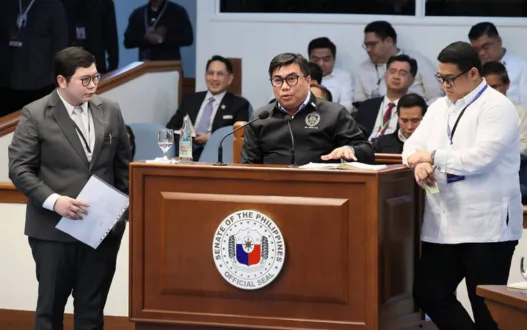
A central element of the testimony provided by NBI Director Melvin Matibag involved explaining the technical methodology used by investigative bodies when evaluating public statements made against high-ranking government officials. The inquiry focused on public press conferences held by Vice President Duterte, during which she made remarks suggesting she had instructed an intermediary to take action against top executive leaders if harm should come to her.
While defense representatives maintained that these statements were mere political hyperbole, emotional outbursts, or rhetoric taken out of context, NBI Director Melvin Matibag detailed how law enforcement bodies evaluate such incidents using standardized threat-assessment protocols. He noted that the bureau employs systematic matrix models similar to those used by the United States Secret Service and international protective agencies.
“I am a witness telling what I know as an NBI director and based on the procedure, established procedure meron pong proseso na ginagamit ng Secret Service to determine na national threat, doon po natin in-apply iyan,” NBI Director Melvin Matibag testified before the Senate court.
Under these standardized investigative metrics, statements containing explicit references to targeting executive leaders cannot be casually dismissed by law enforcement. According to NBI Director Melvin Matibag, applying systematic risk-evaluation models ensures that investigative agencies act purely out of an institutional obligation to protect national stability, removing personal subjectivity from the evaluation process.
Senate Floor Debates and the Question of Procedural Fairness
The court appearance of NBI Director Melvin Matibag sparked dynamic discussions among members of the Senate sitting as an impeachment court. Earlier in the week, Senator Robin Padilla raised questions with lead House prosecutor Gerville Luistro, suggesting that the prosecution panel’s presentation appeared heavily tilted against the Vice President. Senator Padilla later clarified his comments, noting that he was not attacking the integrity of individual witnesses but was advocating for overall procedural fairness and a balanced presentation of facts.
In addressing the broader atmosphere of political tension surrounding the trial, NBI Director Melvin Matibag reiterated that law enforcement officers do not enter the impeachment court as political advocates. He stressed that the bureau’s sole responsibility is to submit verified agency dockets, while the constitutional authority to evaluate, weigh, or dismiss that evidence belongs exclusively to the senator-judges.
“At the end of the day, it is up to the impeachment court to determine the weight of the testimony,” NBI Director Melvin Matibag acknowledged, maintaining a clear separation between executive investigative duties and legislative judicial functions.
The Broader Context of the Trial and Defense Responses
While the prosecution panel utilized the official agency dockets presented by NBI Director Melvin Matibag to construct its narrative on Article IV, Vice President Sara Duterte’s defense team has remained resolute in countering the allegations. Defense spokespersons, including Atty. Michael Poa, have repeatedly stated that the Vice President is not violent and that her public statements have been sensationalized to create a false portrayal of her character.
At the same time, the impeachment trial has expanded into other significant legal battlegrounds. Senate President Francis “Chiz” Escudero recently issued rulings granting the prosecution’s request to subpoena financial, banking, and Anti-Money Laundering Council (AMLC) records associated with the Vice President. While legal analysts point out that the prosecution has gained significant momentum through these financial subpoenas, the testimonial evidence submitted by NBI Director Melvin Matibag remains the primary focal point for the grave threats charge outlined in Article IV.
Institutional Integrity and Law Enforcement Mandates in High-Profile Inquiries
The appearance of NBI Director Melvin Matibag before the Senate impeachment court serves as a critical example of how public law enforcement institutions navigate politically charged environments. When national security concerns intersect with high-stakes political proceedings, the burden of proof rests heavily on the quality, authenticity, and objectivity of the evidence presented by state investigators.
Throughout his testimony, NBI Director Melvin Matibag repeatedly returned to the core concept of institutional responsibility. In any democratic government, executive law enforcement agencies such as the National Bureau of Investigation are tasked with upholding the rule of law without regard to the political status of the individuals involved. By emphasizing that the bureau’s findings were generated through standard open-source intelligence collection, cross-agency risk protocols, and formal task force dockets, NBI Director Melvin Matibag sought to demonstrate that the agency’s actions were standard administrative responses rather than customized political attacks.
Law enforcement professionals note that when public officials make statements that could imply security risks to top executive leaders, investigative agencies do not have the discretion to ignore them. An official investigation must be opened to determine whether a genuine threat exists, whether operational planning has occurred, and whether actionable steps have been taken by third parties. In this context, NBI Director Melvin Matibag framed the bureau’s investigative dockets as necessary measures designed to safeguard national leadership and preserve public confidence in national security systems.
Furthermore, the legal reliance on the custodian of records exception reinforces the institutional nature of the evidence. Individual officers, investigators, and directors may transition in and out of public office, but official records created during the performance of public duties remain permanent administrative fixtures. By testifying on the basis of these official dockets, NBI Director Melvin Matibag established an evidentiary bridge connecting routine agency documentation directly to the legislative record of the Senate impeachment court.
Institutional Neutrality and Future Proceedings
As the Senate impeachment court pauses its daily sessions to accommodate legislative business and the upcoming State of the Nation Address (SONA), NBI Director Melvin Matibag confirmed that the National Bureau of Investigation will maintain its focus on core law enforcement functions. He reiterated that investigative agencies must remain firmly anchored in institutional neutrality, serving the rule of law regardless of political developments or the high stature of the individuals involved.
The testimony delivered by NBI Director Melvin Matibag highlights the delicate balance between high-stakes political drama and strict adherence to legal procedure. When the Senate reconvenes to hear further arguments, the court’s final assessment of official record exceptions and threat matrix standards will play a decisive role in determining whether Article IV carries sufficient evidentiary weight under constitutional standards.
Stay updated with the latest news at Metro Balita PH.