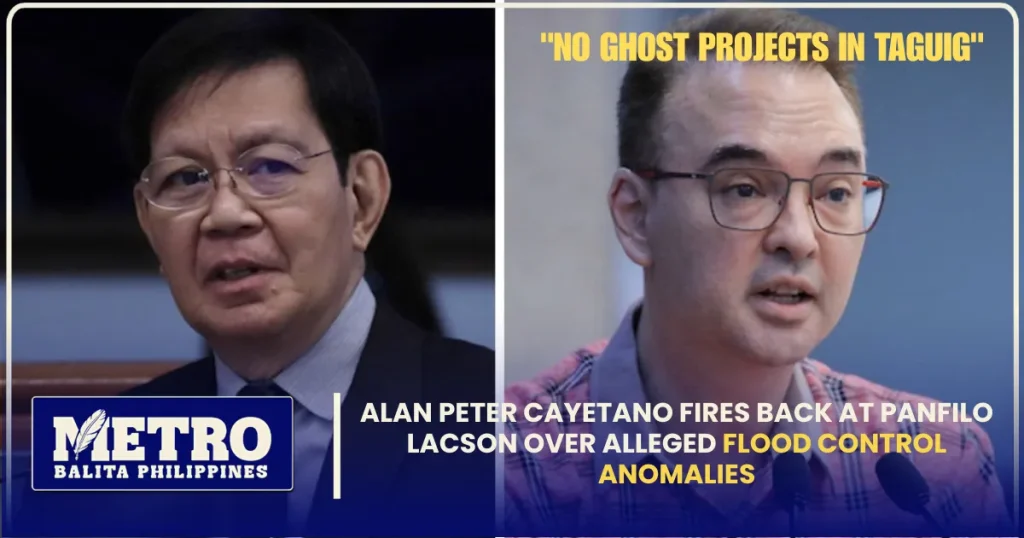
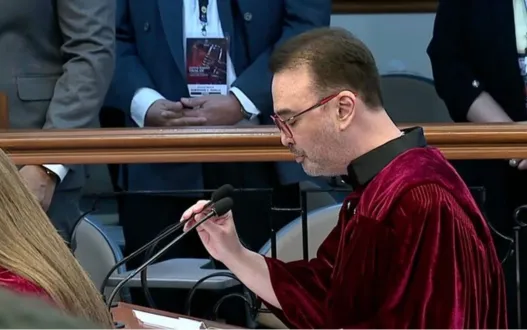
MANILA, Philippines — In a fierce defense of his home city’s governance, Senate Minority Leader Alan Peter Cayetano categorically denied allegations surrounding the existence of ghost projects in Taguig. Addressing the public directly, the veteran lawmaker challenged his critics to bring forth concrete, verifiable proof of infrastructure anomalies, declaring that multiple independent government investigations have already cleared the city administration of any wrongdoing.
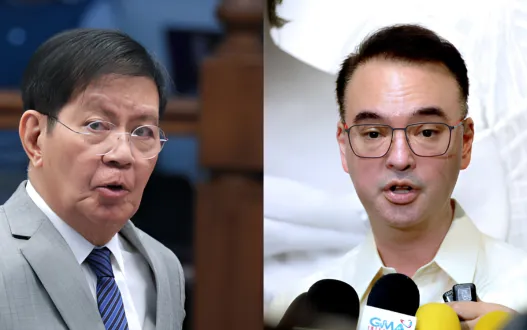
The high-stakes political standoff began after Senator Panfilo Lacson publicly alleged that substantial funding meant for flood control initiatives in Taguig City had been funneled into non-existent or unexecuted public works. Cayetano used a casual, unedited Facebook livestream to counter the claims point by point. He told viewers that the persistent rumors regarding ghost projects in Taguig are completely baseless, stating they are unsupported by official government data, state audits, or real-world physical tracking.
“There are no ghost projects in Taguig. If you can show one, someone should be held accountable,” Cayetano said during his live broadcast. His remarks mark a sharp escalation in a growing Senate feud over how critical flood-mitigation funds are distributed, managed, and audited across Mega Manila’s increasingly vulnerable urban landscapes.
Senate Blue Ribbon Committee Ready to Investigate Taguig Infrastructure Spending
The ongoing verbal battle has formally caught the attention of legislative investigators on Capitol Commons. Senator Erwin Tulfo, chairperson of the powerful Senate Blue Ribbon Committee, confirmed that the panel is planning to launch a formal inquiry into the city’s flood control infrastructure expenditures. The upcoming legislative review ensures that the controversy over ghost projects in Taguig will remain a focal point of intense national debate in the coming weeks.
Interestingly, the political pressure to scrutinize these projects is not just coming from outside rivals. Tulfo revealed that the Senate Minority Leader’s own brother, People’s Television Network (PTV) General Manager Lino Cayetano, had previously asked authorities to carefully examine the efficiency and implementation metrics of local civil works. This unexpected family dynamic has added a layer of complexity to an already tense political situation.
Far from avoiding a congressional showdown, Alan Peter Cayetano welcomed the legislative scrutiny. He revealed that he had already challenged the Blue Ribbon panel to carry out the investigation to its absolute conclusion. He noted that a transparent, public review is the best way to permanently dismantle the rumors of ghost projects in Taguig. According to the Minority Leader, a formal hearing will give the city a chance to prove to the public that its flood infrastructure assets are real, functional, and fully accounted for.
Multiple Independent Audits Clear Taguig of Fraudulent Infrastructure Claims
To support his defense, Cayetano pointed to previous investigations conducted by constitutional fiscal watchdogs and national law enforcement entities. The lawmaker revealed that the Office of the Ombudsman had already thoroughly scrutinized various infrastructure programs throughout Taguig. Following an intensive review of municipal receipts, procurement records, and physical site inspections, the anti-graft agency found no evidence of any ghost projects in Taguig.
In addition to the Ombudsman’s findings, Cayetano noted that a separate national law enforcement agency had conducted its own independent audit of local infrastructure disbursements. That secondary investigation reached the exact same conclusion, finding zero evidence that public funds were being spent on phantom developments.
| Investigating Agency | Findings / Outcome |
| Office of the Ombudsman | Cleared; No anomalous or ghost works found |
| National Law Enforcement Org | Confirmed; Asset verification successful |
| Legislative Office Review | Validated; Zero non-implemented payouts |
Cayetano further explained that his personal congressional staff and legal team conducted their own internal audit of local projects as soon as the rumors began circulating. This review cross-referenced financial disbursements against real-world completion logs for physical structures. The lawmaker reiterated that their internal investigation uncovered no instances where contractors were paid for public works that failed to materialize on the ground.
Cayetano Calls Out Selective Political Focus, Demands Fair Scrutiny for Other Cities
A major part of Cayetano’s counteroffensive focuses on what he describes as a biased, highly localized political attack. The Minority Leader openly accused Senator Lacson of unfairly isolating Taguig City for criticism, arguing that severe flooding is a massive, systemic problem that affects every single local government unit across Metro Manila.
He argued that if lawmakers are truly committed to structural transparency and improving flood control strategies, their inquiries should look beyond just one city. Cayetano pointed out that major flood mitigation challenges and massive expenditure budgets also exist in other prominent urban centers, such as Quezon City and the City of Manila.
The Senator argued that by focusing exclusively on the narrative of ghost projects in Taguig, critics are exposing a partisan agenda rather than a sincere interest in public accountability. He emphasized that a comprehensive, unbiased investigation covering all metropolitan flood control initiatives would be far more useful for the country’s disaster-resiliency goals.
Putting the Burden of Proof on Accusers and Pushing for DPWH Reform
Throughout his address, Cayetano placed the burden of proof squarely on his accusers, challenging them to present tangible documentation instead of relying on political rhetoric. The core of his argument is that allegations of ghost projects in Taguig cannot survive close financial or physical inspection because the infrastructure in question actually exists on the ground.
To prevent future instances of political mudslinging and improve public transparency, Cayetano offered a systemic recommendation for national infrastructure managers. He urged the Department of Public Works and Highways (DPWH) to introduce stricter, digitized documentation protocols for all completed public works across the country.
“Local government units and district engineers should be strictly required to thoroughly document, photograph, and archive every single phase of completed infrastructure. Comprehensive visual and digital logging is the single best way to verify assets and immediately disprove unfounded claims of ghost projects in Taguig.
By creating open-access, verifiable digital repositories of public works data, Cayetano believes the national government can protect local administrations from politically motivated rumors. Until these documentation standards are universally enforced, the senator promised to aggressively contest any unsubstantiated claims that threaten to damage the reputation of his home district.
The Broader Implications of Metro Manila’s Battle Over Flood Control Funds
As heavy rains continue to test the endurance of Metro Manila’s drainage systems, the stakes surrounding flood control budgets have never been higher. Billions of pesos are allocated every year to keep low-lying economic hubs from grinding to a halt during the monsoon season. Because of this, allegations concerning ghost projects in Taguig carry heavy political consequences, threatening to impact public trust, future local elections, and national budget debates.
Political observers note that the clash between Lacson and Cayetano highlights long-standing tensions over how national funds are distributed to local engineering districts. Because flood control projects are often subterranean or localized—such as pumping stations, box culverts, and drainage widening—they are historically vulnerable to public suspicion regarding their true completion status and real-world usefulness.
By welcoming a formal Blue Ribbon Committee review, Cayetano hopes to turn the political tide in his favor. A clean bill of health from the Senate panel would not only dismantle the narrative of ghost projects in Taguig, but also reinforce his standing as a defender of local governance integrity. At the same time, the upcoming hearings will give critics a national stage to dissect municipal spending books, ensuring that Metro Manila’s infrastructure transparency stays at the top of the national news cycle.
Chronology of the Taguig Infrastructure Oversight Debate
The current friction in the Senate is the result of months of intensifying debates over infrastructure oversight. The timeline below tracks how localized infrastructure questions grew into a national legislative standoff.
Lacson Raises Initial Infrastructure Warnings
Early Legislative Sessions
Senator Panfilo Lacson raises formal questions on the Senate floor regarding the structural integrity and financial efficiency of metropolitan flood control allocations, focusing heavily on coastal urban sectors.
Ombudsman and Law Enforcement Review
Mid-Auditing Cycle
The Office of the Ombudsman and an independent law enforcement agency complete separate asset verification missions in Taguig, finding no evidence of non-existent or phantom civil works.
Formal Accusations of Phantom Works
July 2026
Public statements link regional flooding issues to alleged non-executed initiatives, generating widespread media coverage regarding potential ghost projects in Taguig.
Cayetano Livestream Response
Sunday, July 19, 2026
Senate Minority Leader Alan Peter Cayetano launches a comprehensive livestream defense, denying all claims of ghost projects in Taguig and demanding equal investigative scrutiny for Manila and Quezon City.
Blue Ribbon Committee Commitment
July 20, 2026
Blue Ribbon Chairperson Senator Erwin Tulfo confirms an impending formal investigation into the city’s flood control infrastructure, sets parameters for public hearings.
A Direct and Conversational Breakdown of the Dispute
To cut through the dense political jargon, the entire issue comes down to a fundamental disagreement over verification. On one side, critics argue that because deep-drainage systems and underground flood interceptors are out of sight, they require extraordinary, line-by-line physical verification to ensure that taxpayers aren’t funding empty promises. On the other side, the Taguig local leadership argues that their completed pumping units, retaining walls, and upgraded urban waterways are open for anyone to see and are already functioning daily to keep floodwaters at bay.
The Department of Public Works and Highways has not yet issued an official statement regarding Cayetano’s proposal for a mandatory digital engineering archive. However, urban planners and regional observers agree that increased transparency is absolutely necessary to restore public confidence. Whether the upcoming Senate hearings uncover hidden financial discrepancies or completely clear the city of any ghost projects in Taguig, the final resolution will likely reshape how public works are monitored, archived, and managed across the Philippines for years to come.
Stay updated with the latest news at Metro Balita PH.