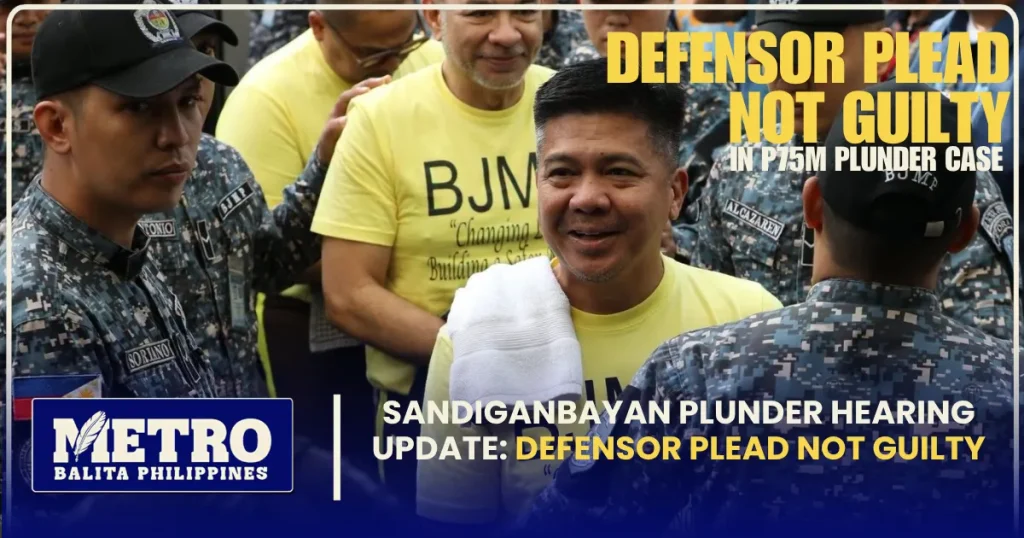
MANILA, Philippines — In a major institutional development unfolding within the anti-graft court, former Anakalusugan Party-list Representative Mike Defensor, alongside two private corporate co-accused, formally entered a plea of not guilty during their highly anticipated arraignment before the Sandiganbayan Third Division on Wednesday morning. The judicial proceeding marks a critical turning point in the high-profile, non-bailable plunder case that has captured national attention, putting several prominent political and business figures under intense legal scrutiny. The decision to watch Defensor plead not guilty signals a clear intent from the defense to aggressively challenge the state’s case.
The severe anti-graft case stems from allegations surrounding a massive financial transaction involving the defendants during the early months of the 2025 election cycle. According to the official charge sheet submitted by state prosecutors, the move to see Defensor plead not guilty comes in response to allegations that he, alongside private businessmen Joseph Espiritu and Aristotle Viray, conspired to funnel a total of P75 million to sitting Senator Rodante Marcoleta. Under the strict provisions of Philippine anti-graft legislation, the sheer magnitude of this undeclared campaign financial transaction elevated the charges to plunder—a capital offense that carries no automatic provision for bail, thereby drastically raising the stakes for all parties involved in the ongoing litigation.
As the court convened for the scheduled morning hearing, public and media anticipation was incredibly high regarding how the defense would approach the formal reading of the charges. Court observers quickly noted that the decision to see Defensor plead not guilty serves as a clear indicator that the defense team intends to aggressively contest the prosecution’s narrative, challenge the financial timelines presented by the state, and thoroughly look to dismantle the evidence gathered by the government. The formal plea sets the stage for a protracted, high-stakes legal battle in the anti-graft court, with both sides preparing to present extensive documentation, bank records, and witness testimonies in the coming months.
The Details Behind the P75 Million Plunder Allegations
The core of the prosecution’s argument rests entirely on the tracking, origin, and ultimate intent behind the P75 million sum. State investigators allege that the massive financial transaction was not a standard political contribution or a benign donation, but rather a highly coordinated effort that satisfies the legal definitions of plunder. The prosecution is expected to argue that the funds were handled in a manner that deliberately subverted standard government transparency protocols, aiming to establish a clear line of criminal liability connecting the former lawmaker and the two private businessmen to the receiving official.
Defensor’s legal team, however, has signaled a remarkably robust defense strategy. By ensuring that the public witnessed Defensor plead not guilty, the legal defense team is emphasizing their firm stance that the transactions in question do not meet the strict legal thresholds required to constitute the crime of plunder. Legal experts note that for a plunder charge to stick, the prosecution must prove a systematic pattern of criminal behavior and the accumulation of ill-gotten wealth totaling at least P50 million. The defense is expected to heavily scrutinize the state’s evidence regarding how these funds were categorized and whether any personal gain or systemic corruption can be definitively proven.
The inclusion of private individuals in a state plunder case adds another deep layer of complexity to the proceedings. Businessmen Joseph Espiritu and Aristotle Viray find themselves facing identical non-bailable charges alongside the former legislator. Like the primary political figure in the case, both businessmen mirrored the move to ensure they and Defensor plead not guilty, presenting a unified front against the state’s allegations. Their respective defense strategies will likely focus on completely decoupling their corporate financial activities from any alleged political favors or illegal schemes.
Understanding the Statutory Definitions of Plunder
To understand the severity of the situation, one must look at Republic Act No. 7080, the Philippine law that governs the crime of plunder. The law states that any public officer who, by himself or in connivance with members of his family, relatives by affinity or consanguinity, business associates, subordinates or other persons, amasses, accumulates or acquires ill-gotten wealth through a combination or series of overt or criminal acts shall be guilty of the crime of plunder. Because the transaction involves P75 million, it comfortably surpasses the statutory minimum threshold of P50 million.
The strategy to have Defensor plead not guilty directly challenges whether a “combination or series” of overt acts actually occurred. The defense will likely argue that a singular donation, regardless of the amount, cannot legally be construed as a series of corrupt practices intended to build an empire of ill-gotten wealth. This specific legal distinction will form the primary battlefield between the state prosecutors from the Office of the Ombudsman and the defense attorneys representing the accused.
Legal Strategies Intensify as Defensor Plead Not Guilty in Court
The formal arraignment room at the Sandiganbayan Third Division was tightly packed with journalists, legal observers, and security details as the charges were read aloud. The exact moment that Defensor plead not guilty echoed clearly through the courtroom, establishing the official start of the trial phase. This development means that the anti-graft court will now move forward with mandatory pre-trial conferences, where both the prosecution and the defense will stipulate facts, identify their final witnesses, and mark the specific pieces of evidence that will be admissible during the main trial.
| Parameter | Case Profile Details |
| Case Type | Plunder (Non-Bailable) |
| Primary Accused (Arraigned) | Mike Defensor |
| Co-Accused (Arraigned) | Joseph Espiritu, Aristotle Viray |
| Co-Accused (Arraignment Pending) | Sen. Rodante Marcoleta |
| Amount Involved | Php 75,000,000.00 |
For the prosecution, the upcoming legal phases will involve demonstrating that the P75 million was part of a broader, illicit deal designed to yield political influence or financial leverage. They will attempt to show that the interaction between the private sector actors and the public officials crossed the line into systemic exploitation of public trust. Conversely, the strategy behind having Defensor plead not guilty rests on breaking down the prosecution’s narrative piece by piece, arguing that the funds were legitimate corporate or personal movements and that the essential elements required to prove plunder are visibly absent from the state’s filing.
Legal analysts are closely watching how the defense handles the non-bailable status of the charge. In many high-profile Sandiganbayan cases, defendants facing non-bailable offenses routinely file immediate petitions for bail, arguing that the evidence of guilt presented by the state is not strong. Now that observers have watched Defensor plead not guilty, the filing of a formal petition for bail is widely considered the next logical step for the defense team, which would force a “mini-trial” where the prosecution must preview its strongest evidence to justify keeping the accused detained throughout the duration of the trial.
The Role of Corporate Entities in Political Cases
A major aspect of the upcoming trial will be the scrutiny of the financial pathways used by the accused businessmen. The prosecution intends to introduce corporate ledgers, bank transfers, and audit trails to prove that the P75 million was funneled through specific corporate accounts to obscure its true nature. The defense, maintaining the stance that saw Defensor plead not guilty, will counter by showing that all corporate financial movements complied with standard accounting practices and lacked any criminal intent.
Legal scholars point out that prosecuting private individuals for plunder requires proving they acted as principals or accomplices to a public officer’s corrupt accumulation of wealth. If the defense can prove that the private businessmen acted independently or without criminal knowledge of an illicit scheme, the prosecution’s case could fall apart. This makes the corporate defense just as vital as the political defense in the upcoming Sandiganbayan sessions.
The Status of Senator Rodante Marcoleta’s Arraignment
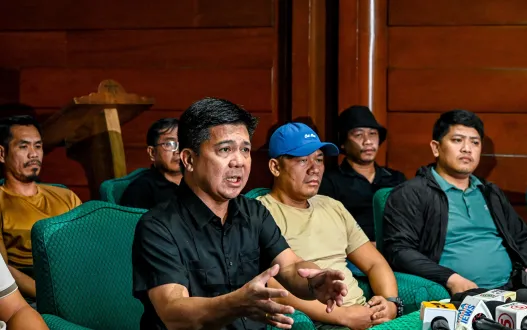
While the three co-accused moved forward with their formal pleas, the situation regarding Senator Rodante Marcoleta remains distinctly unresolved. Senator Marcoleta, who also arrived at the Sandiganbayan in Quezon City for the scheduled hearing, was not formally arraigned alongside the others. The delay in his arraignment is due to a pending motion to quash that his legal team filed before the anti-graft court. A motion to quash is a procedural request asking the court to completely dismiss the charges on the grounds that the information filed by the prosecution does not constitute a legal offense, or that the court lacks jurisdiction over the matter.
Because of this pending motion, the court had to defer Marcoleta’s arraignment until a formal ruling could be issued on his bid to junk the case. This creates a staggered timeline for the litigation, where one group of defendants has already seen Defensor plead not guilty and entered the trial track, while the primary recipient of the alleged funds is still fighting to prevent the case from proceeding to trial at all. Should the court deny Marcoleta’s motion to quash, he will be required to return to the Sandiganbayan to enter his own formal plea.
The outcome of Marcoleta’s pending motion will have a profound impact on the overall trajectory of the trial. If the court decides to dismiss the charges against the senator, it could significantly weaken the prosecution’s case against the remaining defendants who watched Defensor plead not guilty. If the motion is denied, the prosecution will likely seek to immediately consolidate the trials, bringing all individuals back into a singular, unified proceeding to streamline testimonies, protect witness timelines, and present financial records cohesively.
Procedural Next Steps for the Court
The Sandiganbayan Third Division must now resolve the motion to quash before any joint trial schedules can be finalized. The prosecution has already filed its opposition to Marcoleta’s motion, asserting that the indictment is sound and that the facts presented are more than sufficient to warrant a full trial. The justices will review the written arguments from both sides before issuing a resolution.
While this procedural review takes place, the court will proceed with the preliminary conferences for Defensor, Espiritu, and Viray. The separation of timelines is a common occurrence in complex, multi-defendant anti-graft cases, but it requires the court to exercise tight administrative control to prevent unnecessary delays or conflicting rulings within the same case file.
Political and Institutional Repercussions of the Trial
The dramatic developments at the Sandiganbayan are reverberating rapidly through the local political landscape. Plunder cases involving former representatives and sitting senators invariably carry heavy political consequences, raising serious questions about accountability, transparency in campaign finance, and the regulation of large public donations. The public stance to watch Defensor plead not guilty underscores a broader systemic tension between government anti-corruption bodies and high-ranking political figures who maintain that the charges against them are politically motivated or legally flawed.
As the case transitions into the heavy evidentiary phase, the Sandiganbayan’s handling of the P75 million documentation will serve as a major indicator of how stringently the court evaluates complex financial flows between private businesses and public figures. The decision to ensure that Defensor plead not guilty means the public will be treated to a full display of the prosecution’s investigative findings, including bank records, transaction receipts, and potential witness depositions that seek to outline exactly how the alleged P75 million transaction occurred.
For now, the anti-graft court’s Third Division is focused on strict procedural compliance. With the formal declarations recorded and the reality that Defensor plead not guilty firmly established on the court docket, the judiciary must balance the right to a speedy trial for the accused against the state’s duty to thoroughly prosecute cases involving large sums of public interest. The coming weeks will see the court rule on Marcoleta’s motion, an outcome that will dictate the full scope of this legal battle.
Impact on Public Trust and Governance
The broader implications of this trial extend to the public’s perception of political integrity in the Philippines. Anti-corruption advocates argue that high-profile arraignments demonstrate that the legal system is capable of holding powerful individuals accountable. However, critics point out that the slow pace of plunder cases can sometimes dull the public impact of these proceedings over time.
By choosing to see Defensor plead not guilty rather than pursuing any form of legal compromise, the defendants are betting on a complete exoneration. This high-stakes strategy means that the final verdict will have a lasting impact, either reinforcing the government’s anti-corruption mandate or dealing a blow to the credibility of the state’s investigative arms.
What to Expect Next in the Sandiganbayan Proceedings
With the formal arraignment concluded for the majority of the accused, the legal system moves into its next structured phases. The immediate next step for the defendants who watched Defensor plead not guilty will be navigating the strict pre-trial guidelines enforced by the Sandiganbayan. During this phase, the court will attempt to narrow down the issues to ensure that the actual trial does not get bogged down by undisputed facts, focusing strictly on the core of the P75 million allegation.
Furthermore, public interest groups and legal watchdogs are expected to closely monitor the detention status of all individuals involved. Given the non-bailable nature of plunder, the logistics of housing high-profile defendants during a lengthy trial present unique security and administrative challenges for the Bureau of Jail Management and Penology (BJMP) and the anti-graft court. The strategic choice to have Defensor plead not guilty ensures that the legal battle will be fought entirely on the merits of the evidence, leaving no room for quick settlements or plea bargains at this stage of the process.
As the Sandiganbayan Third Division prepares its next calendar of hearings, the focus remains divided between the impending trial of those who pleaded not guilty and the resolution of the outstanding motions filed by the defense. The case stands as a stark reminder of the strict legal frameworks governing financial transactions involving public officials in the Philippines, ensuring that the trial will remain a dominant fixture in national news for the foreseeable future.
Stay updated with the latest news at Metro Balita PH.