MANILA, Philippines — Filipino consumers, motorists, and the local transport sector are bracing for a massive financial shock at the pumps as an unprecedented oil price hike starting next week is projected to take effect. According to reliable oil industry sources citing the latest tracking of the Mean of Platts Singapore (MOPS) and international foreign exchange averages, pump prices for both diesel and gasoline are set to escalate sharply. This impending oil price crisis follows weeks of unstable global market conditions, dealing a severe blow to public utility drivers and private vehicle owners alike who are already navigating a highly vulnerable economic landscape.
The sheer magnitude of the oil price hike starting next week has forced regional transport networks and economic analysts to sound alarms over its secondary effects on food logistics, public transit fares, and the broader cost of living nationwide. For the average Filipino household, fuel adjustments of this scale are never just numbers on a gas station board—they directly dictate the price of regular grocery items, fish, vegetables, and the daily cost of commuting to work or school. When fuel rates explode by double digits in a single week, the entire financial ecosystem feels the strain, highlighting how deeply dependent the local market remains on international energy supply chains.
Big-Time Fuel Price Adjustments on the Horizon
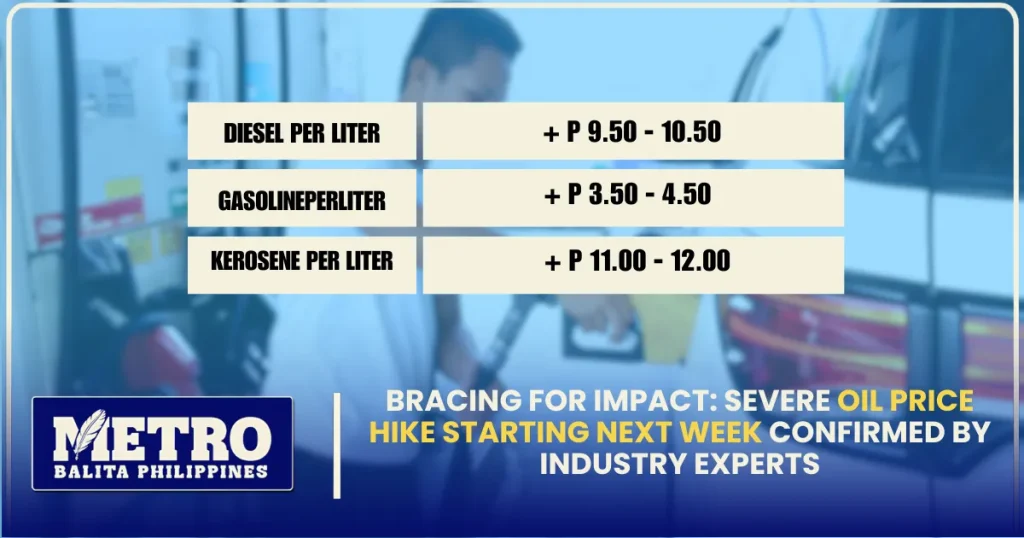
Based on the trading data collected throughout the week, the projected price adjustments show a steep, upward trajectory that will deeply affect consumer spending. Oil industry insiders have provided the following estimated ranges for the fuel price movement, which are expected to be formally implemented by local oil companies on Tuesday:
- Diesel: Increase of P9.50 to P10.50 per liter
- Gasoline: Increase of P3.50 to P4.50 per liter
This incoming adjustment marks one of the most severe weekly price increases recorded in recent years, contrasting sharply with previous minor rollbacks and adjustments. Drivers are already mapping out where to fill up their tanks before the oil price hike starting next week officially drains their wallets. The price gap between diesel and gasoline has also re-ignited discussions on whether alternative fuel options or energy conservation measures can offer long-term financial safety. For commercial fleets and logistics companies that consume thousands of liters every week, this sudden jump translates directly into millions of pesos in unplanned operational expenses.

Why a Massive oil price hike starting next week Is Unavoidable
To understand the core drivers behind the massive oil price hike starting next week, market analysts point directly to escalating geopolitical friction in critical international trade corridors. The primary catalyst is an elevated geopolitical risk premium that has rapidly rebuilt in the global market following aggressive military actions in the Middle East.
An industry source explained that international crude and refined petroleum prices surged after Iranian forces attacked commercial vessels attempting to transit the Strait of Hormuz outside the traditional Iranian-approved sea lanes. In response to these maritime provocations, the United States military executed targeted retaliatory strikes on Iranian military assets in the region. These developments have heavily disrupted standard shipping logistics, stoking deep-seated fears among global traders of a prolonged supply bottleneck that directly triggered the anticipated oil price hike starting next week.
Beyond the immediate crossfire, a strict naval blockade enforced by the United States on vessels traveling to and from major Iranian ports has significantly restricted oil flows. Because the Strait of Hormuz serves as a vital global choke point for a vast portion of the world’s daily petroleum supply, the sharp decline in vessel traffic has severely tightened product balances. Compounding the situation in the Middle East, the global market is also dealing with a steep decline in diesel exports out of Russia, which has further starved the international supply chain of refined products and accelerated the price surge.
Understanding the Geopolitical Drivers and Market Impact
The combination of shipping bottlenecks and export caps has left developing economies like the Philippines highly exposed to external price shocks. Because the local oil industry operates under a deregulated framework, domestic oil companies pass down the costs calculated from the weekly MOPS averages almost immediately.
“World oil prices are mainly supported by an elevated geopolitical risk premium… Worries of supply disruption, tightening product balances as vessel traffic in the Strait of Hormuz declined sharply, and the US naval blockade of ships to and from Iranian ports have pushed prices higher.” — Oil Industry Source
For public utility vehicle (PUV) drivers, a oil price hike starting next week means that daily operational costs will consume an even larger portion of their hard-earned revenues. Jeepney, bus, and UV Express operators rely almost exclusively on diesel fuel, making them the most vulnerable segment whenever global energy supply lines experience heavy volatility. Many transport workers are left wondering how they will cope once the oil price hike starting next week hits the pumps on Tuesday morning. The mental toll on drivers is palpable, as many already spend twelve to fourteen hours on the road just to bring home a diminishing amount of money to their families.
Government Steps Up: Marcos Expands UPLIFT Cash Assistance Program
Recognizing the severe economic strain that the massive oil price hike starting next week will impose on millions of low-income families, the administration of President Ferdinand “Bongbong” Marcos Jr. has moved swiftly to expand social safety nets. The chief executive announced that the national government has widened the scope of the United Package for Livelihoods, Industry, Food, and Transport (UPLIFT) program to provide immediate financial relief.
Through the expanded UPLIFT Assistance initiative, an estimated 7.5 million indigent households—equivalent to roughly 37.5 million Filipinos nationwide—will receive direct cash assistance from the state. This comprehensive deployment aims to cushion the inflationary blow that typically follows a double-digit spike in fuel costs.
| Program Beneficiary Class | Assistance Type | Amount Per Beneficiary | Total Reached |
| 4Ps & Walang Gutom Households | One-time Additional Cash | Up to P2,000.00 | 3.5 Million Households |
| Broad Vulnerable Sector | General UPLIFT Subsidy | Tiered Financial Aid | 7.5 Million Households Total |
According to President Marcos, 3.5 million household beneficiaries currently registered under the Pantawid Pamilyang Pilipino Program (4Ps) and the active Walang Gutom Program will explicitly receive a one-time additional assistance package of up to P2,000. This targeted fiscal intervention is designed to keep food on the table and ensure that basic transportation needs remain affordable for households living below the poverty line, especially as the impending oil price hike starting next week threatens to drive up commodity prices. Government planners emphasize that direct cash injections are the fastest way to support basic consumption while macro-economic pressures filter through the local marketplace.
The Ripple Effect on Agriculture and Domestic Supply Chains
While vehicle owners feel the pain directly at the gas pump, the agricultural sector faces an equally grim reality. Modern farming relies heavily on mechanized tools—from tractors that prepare the soil to water pumps that sustain irrigation systems—and almost all of this machinery runs on diesel fuel. Agricultural advocates note that this massive oil price hike starting next week will directly elevate production costs for farmers who are already dealing with unstable weather conditions and rising fertilizer costs. When a farmer has to spend double to keep their water pumps running, the margins on their crops disappear entirely.
Furthermore, once crops are harvested, they must be transported from remote provinces to major urban distribution centers like Metro Manila. Large cargo trucks, which form the backbone of the country’s agricultural supply chain, consume hundreds of liters of fuel per trip. When logistics operators face a steep price spike, they are forced to adjust their hauling rates to stay profitable. As a result, consumer food staples like rice, local vegetables, and poultry often see sudden price adjustments at retail wet markets within days of a major oil price hike starting next week. This cyclical vulnerability shows how fuel costs act as a hidden tax on every plate of food in the country.
Commuter Woes and the Looming Fare Hike Petitions
For millions of ordinary commuters who do not own cars, the price of fuel still dictates their daily budget. Transport groups and transport cooperatives are already holding emergency meetings to discuss how to manage their shrinking margins. Without immediate government intervention, many operators warn that they will have no choice but to petition the Land Transportation Franchising and Regulatory Board (LTFRB) for provisional fare increases. The looming oil price hike starting next week makes these conversations urgent, as public utility drivers simply cannot absorb a P10.50 per liter increase out of their own pockets.
Past market shocks have shown that fare hikes are difficult to implement smoothly, often causing friction between drivers who need to survive and commuters who cannot afford higher fees. If a transport fare adjustment is approved, it could trigger a secondary wave of inflation, making daily life tougher for minimum-wage earners. Transport advocates argue that a significant oil price hike starting next week makes it urgent for government bodies to speed up the release of fuel vouchers, ensuring public utility drivers do not abandon their routes due to unmanageable operating losses. If drivers choose to stay home rather than operate at a loss, urban centers could experience severe transport shortages.
The Broader Impact on Micro, Small, and Medium Enterprises (MSMEs)
Beyond transport and farming, local neighborhood businesses—such as small bakeries, sari-sari stores, and regional manufacturing shops—are also vulnerable to sudden energy hikes. Many of these businesses rely on third-party delivery services or run small generators and delivery vehicles to serve their communities. As the oil price hike starting next week goes into effect, the operational cost of moving raw goods will increase across the board. Small business owners often face a tough dilemma: absorb the added costs and reduce their slim profits, or raise prices and risk losing their customer base to larger corporations.
For instance, localized manufacturing plants that use diesel generators to buffer against regional power interruptions will see immediate jumps in their production costs. When these micro-economies suffer, it slows down job creation and reduces the spending power of local communities. Financial experts warn that while large corporations possess the capital reserves to ride out global oil spikes, small enterprises are often pushed to the brink by sudden price changes like the oil price hike starting next week. Protecting these smaller entities through localized economic interventions will be just as crucial as supporting the transport sector.
Macroeconomic Strains: Inflation Risks and Policy Implications
From a macroeconomic viewpoint, a sudden double-digit price jump for essential fuels complicates the central bank’s efforts to keep inflation within its target range. The Department of Energy and economic planning agencies are carefully studying the broader data to forecast the upcoming consumer price index adjustments. Since energy costs underpin nearly every sector of the Philippine economy, a prolonged oil price hike starting next week could lead to sticky inflation that dampens consumer spending throughout the second half of the year.
When consumers spend more money at the gas pump or on public transit, they naturally cut back on discretionary purchases, such as dining out, retail shopping, and domestic tourism. This contraction in consumer activity can slow overall gross domestic product (GDP) growth. Consequently, financial institutions may be required to keep interest rates higher for longer to manage inflationary expectations, which in turn increases the cost of borrowing for home loans and commercial expansions. The international tensions driving the oil price hike starting next week serve as a stark reminder of how deeply global geopolitical realities impact local fiscal policy and daily economic life.
Long-Term Outlook for Local Pump Prices and Consumers
As the country prepares for the inevitable oil price hike starting next week, transport groups and economic watchdogs are closely evaluating how long these global supply disruptions will last. If the military standoff in the Strait of Hormuz drags on, or if the naval blockades continue to restrict international trade routes, local fuel costs could remain elevated for the foreseeable future. The international energy landscape remains fluid, and local market analysts warn against expecting immediate rollbacks given the volatile conditions in the Middle East.
Economists warn that a prolonged oil price hike starting next week could eventually trickle down into the retail sector. Higher logistics costs generally lead to increased prices for agricultural products, manufactured goods, and basic grocery items, given that delivery trucks and cargo vessels depend heavily on stable fuel rates. Local government agencies and the Department of Energy (DOE) are continuing to monitor international trading daily, urging oil players to implement the adjustments transparently while appealing to consumers to practice fuel-efficient habits during this global energy crunch.
Ultimately, managing the fallout from the oil price hike starting next week will require a coordinated effort from both commuters and policy makers to ensure economic stability.
Key Takeaways for Motorists Ahead of the Adjustments
To minimize the immediate impact of the heavy fuel price increases scheduled for early next week, vehicle owners and transport operators are advised to plan their logistics ahead of time.
- Refuel Early: Filling up fuel tanks before the official Tuesday morning rollout can yield immediate savings, especially for fleet operators and delivery drivers facing a P10.50 per liter surge. Don’t wait until the oil price hike starting next week goes live.
- Optimize Delivery Routes: Logistics companies should consolidate shipments and map out fuel-efficient routes to counteract the rising operational expenses caused by the fuel spike.
- Monitor Government Portals: Vulnerable transport workers should coordinate with the Department of Transportation (DOTr) and local government units to ensure they are properly registered for incoming UPLIFT subsidies and fuel vouchers to offset the oil price hike starting next week.
The coming days will prove critical as the market adjusts to these massive price increases. With global geopolitical tensions remaining highly unpredictable, both the public and private sectors must remain adaptive to protect the local economy from further external shocks.
For more news and updates, visit Metro Balita Ph.