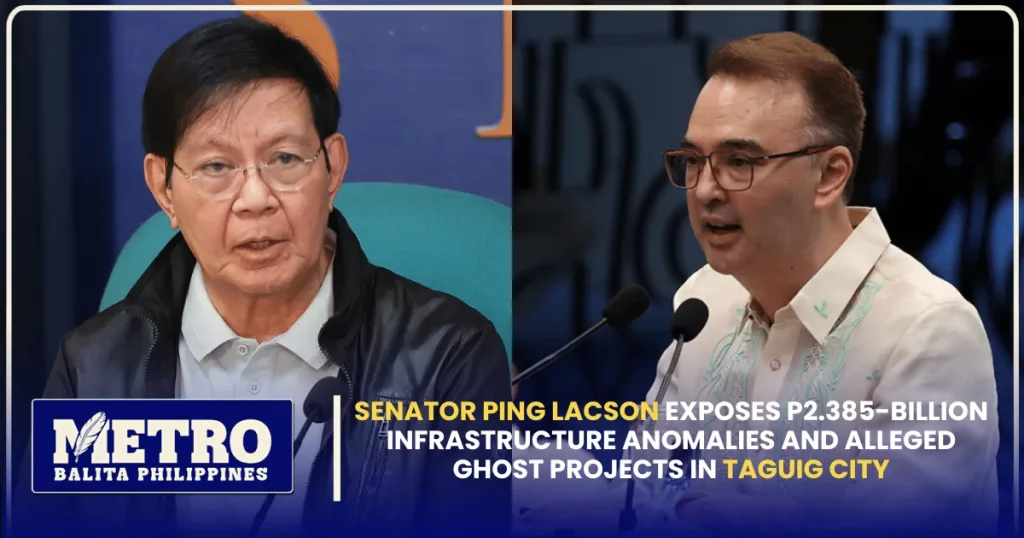
In a massive disclosure that has placed national public works expenditure under intense public scrutiny, former senator Panfilo “Ping” Lacson has bared new irregularities involving multi-million-peso infrastructure allocations in Taguig City. According to the latest findings released by Lacson’s investigative team, three additional slope protection projects—each carrying an identical price tag of P100 million—were embedded into the 2025 General Appropriations Act (GAA). This latest discovery officially raises the total questionable budget insertions identified in Taguig City from an initial estimate of P2.085 billion to a staggering P2.385 billion. More alarmingly, state auditors and investigators identified duplicate line items funding the exact same physical structure, strongly indicating that at least one of the multi-million-peso allocations represents a “ghost project” designed to siphon taxpayer money without delivering actual civil works.
Detailed Breakdown of Budget Anomalies in Taguig City Infrastructure
The latest revelation by Lacson marks a significant escalation in ongoing efforts to audit public works spending across Metro Manila. Writing on his official social media account on X (formerly Twitter) on Wednesday afternoon, July 22, 2026, Lacson detailed how continuing technical checks on the national budget exposed previously overlooked line items assigned to Taguig City.
“From P2.085B as earlier reported we found three-P100M additional slope protection projects for a new total of P2.385B insertions under the 2025 GAA. Two items appear to be double appropriations, involving two (2)-P100M for the same slope protection project. One of the two must be ghost,” Lacson stated.
The funding pattern uncovered in Taguig City highlights a highly methodical approach to budget customization. Rather than lump-sum appropriations designed for major, continuous engineering works, the infrastructure allocations in Taguig City appear systematically broken down into uniform P100-million tranches. State audit experts note that dividing projects into identical financial blocks often serves to evade higher tiers of administrative review or streamline quick release mechanisms within the Department of Public Works and Highways (DPWH).
What makes the current discovery particularly concerning to public finance experts is the presence of explicit double appropriations. In legislative auditing, a double appropriation occurs when two distinct line items in the national budget assign separate funds to the exact same scope of work at the identical location. Because a single riverbank or slope can only be built once, the second P100-million funding allocation for Taguig City exists solely on paper. If disbursed, such funds are drawn against fraudulent completion reports, leaving one of the two projects as an unbuilt ghost project.
How Ghost Projects and Unchecked Insertions Operate in Taguig City
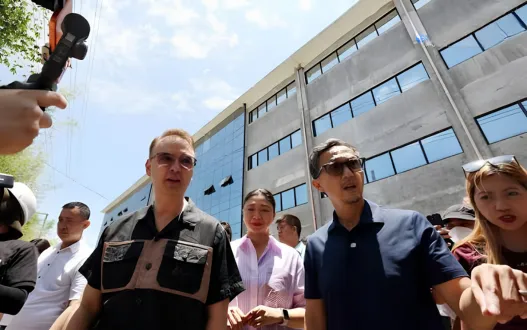
To fully understand the magnitude of these exposed irregularities, one must examine how public works budgeting and civil engineering execution function on the ground in Taguig City. Slope protection barriers and urban drainage channels represent vital infrastructure in low-lying areas prone to monsoon flooding and seasonal overflows from Laguna de Bay and the Pasig River basin. However, because underground culverts and reinforced concrete embankments are difficult to inspect once completed or submerged, they have historically been vulnerable to manipulative accounting practices.
In preliminary briefings, Lacson revealed that the suspicious line items in Taguig City follow a repetitive structural template. Dozens of individual projects were entered into legislative records with generic titles and uniform P100-million budgets. When project descriptions lack precise geographic coordinates, station markers, or detailed engineering parameters, contractors gain significant leeway to overlap project sites or claim credit for previously constructed walls across Taguig City.
The historical timeline of these funding patterns extends back across multiple fiscal cycles:
- 2019–2020 Budget Cycles: Similar slope protection and drainage arrangements in Taguig City date back to when the city served as the central political stronghold for then-House Speaker Alan Peter Cayetano.
- Bicameral Reallocations: During congressional budget deliberations, opposition lawmakers raised frequent concerns regarding disproportionate public works allocations funneled directly into Taguig City.
- Pre-Enactment Insertions: While the Supreme Court outlawed post-enactment pork barrel mechanisms in its landmark 2013 decision on the Priority Development Assistance Fund (PDAF), watchdog groups point out that pre-enactment insertions introduced during bicameral conference committee meetings continue to channel localized funds into Taguig City.
In this case, the sheer volume of identical P100-million insertions indicates a concentrated effort to accumulate infrastructure capital within a single local jurisdiction without undergoing standard DPWH evaluation procedures.
Contractor Links: The Discaya 5% Royalty Scheme and Topnotch Catalyst Builders
A central pillar of Lacson’s ongoing probe centers on the specific private contractors tasked with executing these multi-million-peso civil works throughout Taguig City. The initial audit brought to light an intricate network of subcontracting practices involving companies tied to government contractors Curlee Discaya and Sara Discaya, alongside prominent construction entities such as Topnotch Catalyst Builders.
According to investigative findings, several infrastructure projects in Taguig City were formally awarded to Discaya-owned firms but were subsequently handed over to secondary contractors under an informal royalty agreement. Under this arrangement—commonly referred to in industry parlance as a “royalty scheme”—the original awardee receives an upfront fee, typically around five percent (5%) of the total contract value, simply for lending its license and eligibility. The secondary contractor then assumes full responsibility for construction in Taguig City, often working with a drastically reduced operating budget after accounting for political kickbacks and administrative cuts.
This compromise in funding directly impacts public safety and structural stability in Taguig City:
- Severe Budget Depletion: When a P100-million allocation is pared down by five percent royalty fees, political commissions, and intermediary costs, the actual capital remaining for raw materials, steel rebar, and labor drops precipitously.
- Substandard Civil Works: To maintain profit margins on depleted budgets, contractors frequently resort to weak concrete mixes, reduced excavation depths, or substandard reinforcement along slope barriers in Taguig City.
- Diffused Legal Liability: When primary license holders pass off actual construction to unrecorded subcontractors, assigning legal accountability for structural failures or delayed timelines becomes extremely difficult for state regulators.
Furthermore, the involvement of Topnotch Catalyst Builders in Taguig City infrastructure projects has drawn intense scrutiny. Topnotch Catalyst Builders was previously listed by President Ferdinand “Bongbong” Marcos Jr. among the top 15 flood control contractors nationwide during an executive review of national disaster mitigation programs. The firm’s heavy presence in repetitive and potentially duplicated projects in Taguig City raises sharp questions regarding contractor evaluation and executive oversight.
Political Fallout and Regional Governance Impacts on Taguig City
The exposure of P2.385 billion in questionable infrastructure funding carries deep political ramifications for Taguig City, long regarded as a primary economic engine and commercial center of Metro Manila. For decades, the local political landscape has been led by the Cayetano family, with Senator Alan Peter Cayetano, Senator Pia Cayetano, and Mayor Lani Cayetano holding key leadership posts across local and national government.
As Senate Minority Leader, Alan Peter Cayetano occupies a high-profile role in legislative debates and policy oversight. However, Lacson’s explicit linkage between national budget insertions and Cayetano’s political bailiwick in Taguig City has ignited a heated national discussion on patronage politics and equitable resource distribution.
Civic groups point out that concentrating billions of pesos in flood control and slope protection funding within Taguig City starves neighboring municipalities of essential infrastructure capital. While contiguous communities along the Laguna de Bay basin face severe inundation during heavy typhoons, unbalanced allocations leave regional flood management fragmented and ineffective.
From a local governance standpoint, residents and taxpayers in Taguig City are left questioning whether billions spent on slope protection over the past seven years have yielded real protection. Despite massive annual appropriations, key residential and commercial sectors across Taguig City continue to experience street-level flooding during heavy rains, reinforcing suspicions that public funds were diverted into ghost projects or consumed by intermediary commissions.
Senate Investigations, Ombudsman Referrals, and Legal Accountabilities
As details of the P2.385-billion infrastructure anomaly continue to build, pressure is mounting on legislative bodies and state enforcement agencies to take decisive legal action. Senate colleagues and civic watchdog organizations have called on the Senate Blue Ribbon Committee and the Committee on Public Works to convene joint investigative hearings to examine the 2025 GAA budget insertions in Taguig City.
Senator Ping Lacson emphasized that all documented evidence gathered by his office—including testimonial accounts from witnesses, technical budget line items, and audit worksheets—will be submitted directly to the Office of the Ombudsman for formal fact-finding and preliminary investigation.
Key regulatory steps currently under consideration by oversight agencies include:
- Comprehensive Physical Audits: The Commission on Audit (COA), together with independent structural engineers, must conduct physical and satellite surveys across Taguig City to map every completed and ongoing slope protection project against official DPWH registries.
- Special Fraud Unit Investigation: COA’s Special Audit Office must scrutinize the financial trails of all contracts awarded to Discaya-linked firms and Topnotch Catalyst Builders, specifically tracking the disbursement of project funds, subcontracting agreements, and suspected 5% royalty payments.
- DPWH District Restructuring: Legal advocates are urging an immediate review of the DPWH engineering district overseeing Taguig City to evaluate whether public officials colluded with private contractors to validate false accomplishment reports for double-assigned project sites.
- Mandatory Geotagging Requirements: To eliminate generic P100-million insertions in future budgets, reform-minded lawmakers are pushing for mandatory spatial geotagging for all public works line items before approval in future General Appropriations Acts.
Senator Ping Lacson’s persistent tracking of anomalous line items underscores the crucial role of rigorous budget oversight in protecting public funds. As calls for transparency grow louder across Metro Manila, the investigation into public works allocations in Taguig City stands as a landmark test case for Philippine public finance, anti-corruption enforcement, and structural governance reform.
Stay updated with the latest news at Metro Balita PH.