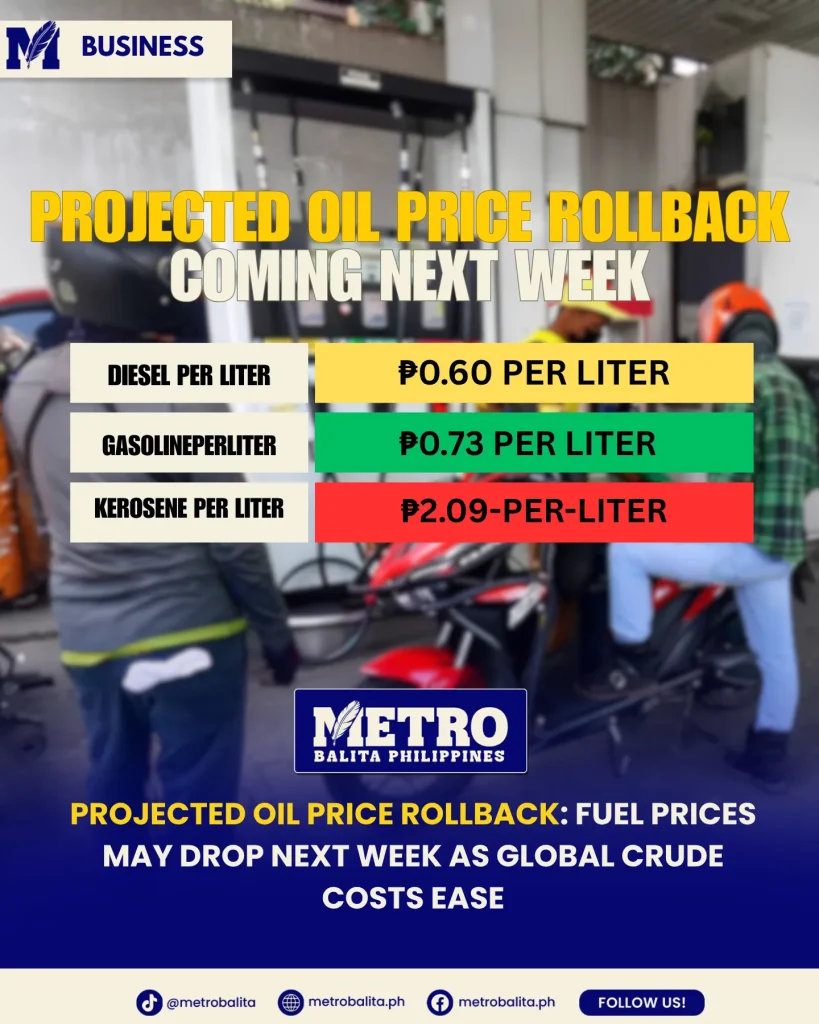
MANILA, Philippines — Philippine motorists, public utility vehicle operators, and daily commuters are slated to receive a modest reprieve at the pump as petroleum companies prepare to implement a fresh oil price roll back starting Tuesday, August 4. The incoming price adjustments will see retail pump rates for both gasoline and diesel decrease by less than one peso per liter, while consumers reliant on kerosene are set to enjoy a significantly larger price drop exceeding two pesos.
During an official press briefing held on Monday morning, Department of Energy (DOE) Secretary Sharon Garin outlined the specific parameters of the impending oil price roll back, noting that local retail fuel prices are tracking recent downward movements within international crude and refined petroleum trading markets.
The upcoming adjustment marks a momentary break from the heavy upward price pressures that have consistently strained household budgets, delivery logistics networks, and commercial transport operations across the archipelago in recent weeks.
Complete Breakdown of the Week’s Oil Price Roll Back
According to official metrics confirmed by the Department of Energy, retail fuel stations operating across the country will implement the following per-liter price reductions:
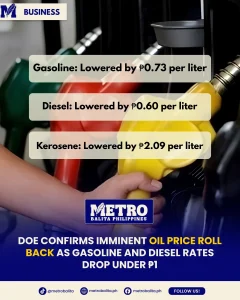
- Gasoline: Lowered by ₱0.73 per liter
- Diesel: Lowered by ₱0.60 per liter
- Kerosene: Lowered by ₱2.09 per liter
To help visualize how this adjustment reflects on standard retail pump rates, the detailed breakdown is provided below:
| Fuel Grade | Price Adjustment Type | Price Cut Amount (per Liter) |
| Gasoline | Rollback | -₱0.73 |
| Diesel | Rollback | -₱0.60 |
| Kerosene | Rollback | -₱2.09 |
While the cuts applied to gasoline and diesel remain below the one-peso mark, the broader oil price roll back delivers critical financial breathing room for transport workers who depend on every cent saved to preserve their daily take-home pay.
Simultaneously, the most dramatic slice of this week’s oil price roll back lands directly in the kerosene category. Households in suburban and rural regions reliant on kerosene for domestic cooking and home lighting, alongside coastal fishing communities using kerosene-powered boats, stand to gain the largest immediate savings from the ₱2.09 per liter reduction.
Energy Department Outlook on the Oil Price Roll Back
Addressing the public during Monday’s media briefing, Energy Secretary Sharon Garin emphasized that while the numerical cuts may appear modest on paper, any form of relief remains vital for everyday citizens navigating elevated living expenses.
“I know that many of you are still feeling the weight of the past week’s increases, but every rollback matters,” Secretary Garin stated. “It means a little less pressure on our drivers, farmers, and small businesses who move this economy every single day.”
However, the Energy Chief tempered consumer optimism by warning that international petroleum dynamics stay highly unpredictable. Geopolitical tensions, particularly surrounding ongoing military friction, ceasefire talks, and trade route security involving the United States and Iran near the Strait of Hormuz, continue to generate sharp swings across global crude benchmarks.
Garin urged both domestic industries and private motorists to maintain prudent fuel consumption practices despite the welcomed oil price roll back.
“This shows the fact that the Middle East conflict is still volatile, and we still have to brace ourselves and be prudent with our spending, as far as fuel is concerned,” Garin noted.
Regarding domestic market stability, Secretary Garin assured consumers that national petroleum inventories remain robust. She confirmed that the country’s fuel stockpiles are currently “strong and stable,” ruling out short-term supply shortages or delivery bottlenecks across provincial distribution networks.
Global Market Mechanics Driving the Oil Price Roll Back
The underlying mechanism behind this weekly oil price roll back rests upon fluctuations within regional commodity trading platforms, specifically the Mean of Platts Singapore (MOPS). MOPS serves as the primary benchmark pricing standard utilized by oil importers and retailers across the Philippines to compute weekly pump price adjustments.
Over the preceding trading week, global crude benchmarks experienced brief downward corrections. Market sentiment was influenced by cautious optimism following announcements of potential diplomatic talks to defuse escalation in the Middle East, coupled with fluctuations in global industrial demand.
Because the Philippines imports virtually all of its refined petroleum products, downward movements in MOPS trading prices directly trigger a corresponding oil price roll back at local pumps after accounting for foreign exchange conversions, shipping freight, and domestic refining costs.
Industry analysts highlight, however, that trading sentiment remains fragile. Any sudden breakdown in diplomatic negotiations, unexpected crude inventory draws, or maritime shipping delays could rapidly reverse current trends and erase the savings generated by this oil price roll back.
Deeper Context: Understanding the Singapore Benchmark (MOPS)
To fully comprehend why local pump prices fluctuate on a weekly cycle, it is necessary to examine how the Mean of Platts Singapore (MOPS) operates as the cornerstone of domestic fuel pricing under the Oil Deregulation Law of 1998 (Republic Act No. 8479).
Platts is a global pricing agency that assesses daily commodity market rates. In Southeast Asia, MOPS reflects the mean of daily trading transactions for refined petroleum products—such as 92, 95, and 98 RON gasoline, gasoil (diesel), and kerosene—traded in Singapore, which functions as the primary refining and trading hub for the region.
When Philippine fuel companies purchase finished petroleum products, the final cost is calculated based on the average MOPS price of the preceding week (Monday through Friday), converted to Philippine Pesos using the prevailing foreign exchange rate, and combined with foreign freight costs, insurance, local taxes, and retail margins.
Consequently, when global crude futures drop during regional trading hours, MOPS prices decline, translating a few days later into a local oil price roll back. Conversely, when international supply disruptions occur, MOPS rates climb, leading to retail price hikes in local service stations.
Macroeconomic Impact Across Key Domestic Sectors
Economic observers emphasize that even an incremental oil price roll back creates positive compounding effects across multiple layers of the national economy:
1. Public Transport Sector and Fleet Operations
Public Utility Vehicle (PUV) drivers—including jeepney, city bus, and tricycle operators—operate under tight daily profit margins. Fuel expenses typically account for up to 50 percent of a driver’s daily operating costs. A reliable oil price roll back eases immediate operational overheads, allowing drivers to preserve their take-home income without immediately petitioning regulatory bodies like the Land Transportation Franchising and Regulatory Board (LTFRB) for emergency fare adjustments.
2. Agriculture and Rural Logistics
In agricultural provinces, diesel fuel powers heavy machinery, tractor units, water pumps for farm irrigation, and refrigerated transport trucks moving fresh harvests to urban markets. Reductions in diesel costs help agricultural producers and logistics providers contain supply chain overhead, helping to stabilize food prices in public markets.
3. Food Delivery and Ride-Hailing Drivers
The rapid growth of ride-hailing services and on-demand delivery apps has created a massive fleet of motorcycle riders who pay for their own fuel out of pocket. For these gig-economy workers, weekly pump fluctuations directly impact daily earnings. An oil price roll back provides immediate financial relief, reducing expenses for thousands of delivery personnel navigating urban traffic daily.
4. Consumer Inflation and Market Sentiment
Petroleum prices carry substantial weight in headline consumer inflation calculations due to their direct influence on transport costs. Easing pump prices through a widespread oil price roll back helps curb overall transport-related inflation, supporting broader consumer purchasing power during periods of economic volatility.
Historical Retrospective: Local Fuel Price Trends
To contextualize this week’s oil price roll back, domestic petroleum prices undergo adjustments every Tuesday morning in response to the prior week’s average trading figures. Over the past quarter, local consumers have experienced a volatile cycle of sharp increases interspersed with occasional rollbacks.
| Adjustment Period | Market Environment | Impact on Local Consumers |
| Prior Weeks | Geopolitical Tension & High Crude Futures | Heavy pump price hikes on diesel and gasoline |
| Current Week (Aug 4) | Regional Trading Corrections & Diplomacy | Confirmed oil price roll back under ₱1 |
| Upcoming Outlook | Subject to MOPS Volatility & Shipping Stability | Highly dynamic market conditions |
Monitoring these broader market cycles illustrates why energy officials advocate for long-term fuel efficiency habits rather than relying solely on individual weekly price cuts.
Government Inventory Safeguards and Monitoring
To safeguard consumers against artificial price gouging during volatile market cycles, the Department of Energy’s Oil Industry Management Bureau (OIMB) enforces strict inventory and compliance monitoring standards across all oil companies operating in the Philippines.
Under existing DOE guidelines, oil companies are mandated to maintain minimum inventory requirements (MIR). Refiners are required to hold a minimum 30-day supply of crude oil and finished products, while direct importers must maintain a 15-day inventory, and LPG marketers must keep a 7-day supply.
These strategic reserves ensure that temporary global trade disruptions or geopolitical flare-ups do not cause immediate physical fuel shortages in the country. Furthermore, OIMB inspectors regularly audit retail gas stations on Tuesdays to ensure that published price cuts from any announced oil price roll back are implemented accurately at the pump without delay.
Practical Measures for Motorists During Fuel Price Changes
While motorists welcome the news of an upcoming oil price roll back, combining lower fuel rates with smart vehicle habits yields maximum long-term savings at the pump:
- Verify Proper Tire Pressure: Driving on underinflated tires increases rolling resistance. Maintaining correct tire pressure ensures optimal fuel economy and prevents premature tire wear.
- Remove Unnecessary Cargo: Carrying excess weight in the trunk or cabin forces the engine to burn more fuel per kilometer, eroding the financial savings gained from an oil price roll back.
- Practice Smooth Acceleration: Aggressive throttle usage and sudden braking consume significantly more fuel compared to gradual, steady acceleration.
- Plan Efficient Trip Routes: Grouping multiple daily errands into a single structured journey avoids engine idle time in dense urban traffic, ensuring every liter purchased during an oil price roll back goes further.

What Consumers Should Expect on Tuesday
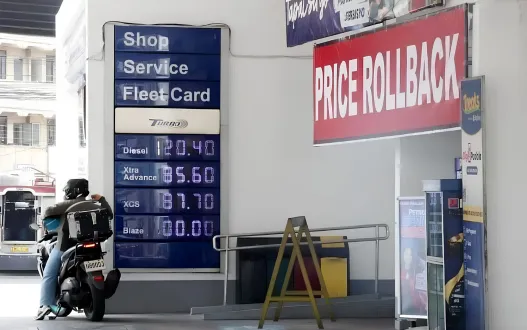
Major fuel distributors and independent petroleum players across the Philippines are scheduled to implement the formal price reductions starting at 6:00 AM on Tuesday, August 4. Motorists planning to fill up their tanks are advised to schedule their service station visits accordingly to take full advantage of the official oil price roll back.
Regulatory bodies, including the Department of Energy and local government consumer protection units, will continue monitoring retail stations nationwide to verify compliance with the announced price reductions and guarantee that all metering pumps accurately reflect the updated pricing structure.
Get the latest news and updates right here on Metro Balita PH.