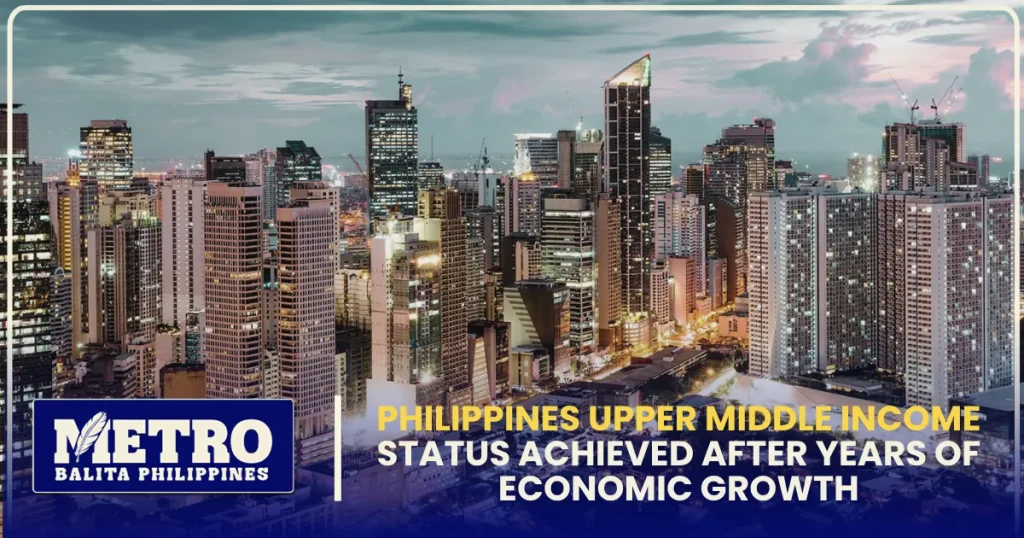
The Philippines upper middle income milestone has officially been reached, marking a major turning point for the country’s economy and long-term development goals. After years of steady economic expansion, infrastructure investments, and reforms aimed at boosting national productivity, the Philippines has now been classified as an upper middle income economy, according to the latest global income classification data.
Economists and government officials described the development as a significant achievement for the country, especially after the economic setbacks caused by the pandemic in recent years. The recognition highlights the improving income levels of Filipinos and reflects stronger economic performance across various industries.
The new classification is expected to strengthen investor confidence, improve the country’s global image, and create more opportunities for economic partnerships and foreign investments moving forward.
Philippines Upper Middle Income Classification Explained
The Philippines upper middle income status means the country has surpassed the income threshold set by international financial institutions for economies transitioning from lower-middle-income classification.
Countries are grouped according to their gross national income or GNI per capita. Once a nation exceeds the required income benchmark, it moves into a higher economic category. For the Philippines, this achievement signals that the country’s average income level has improved significantly compared to previous years.
Economic analysts noted that the country’s strong recovery after the pandemic played a major role in reaching the new classification. Increased consumer spending, remittances from overseas Filipino workers, tourism recovery, and infrastructure projects all contributed to the improvement.
The government also emphasized that the new status reflects the resilience of the Philippine economy despite global inflation concerns, geopolitical tensions, and rising fuel prices that affected many developing nations.
Economic Growth Helped Push Philippines Upper Middle Income Goal
Several factors helped the country achieve the Philippines upper middle income target.
One of the biggest contributors was strong domestic consumption. Filipino households continued spending despite economic uncertainties, helping businesses recover and expand operations. The services sector, which includes tourism, retail, banking, and hospitality, also experienced major improvements over the past year.
Infrastructure development under various government programs likewise played a major role. Roads, airports, railways, bridges, and digital connectivity projects boosted economic activity and created jobs in different regions nationwide.
Foreign investments also increased as global companies looked at the Philippines as a growing market in Southeast Asia. The country’s young workforce, expanding middle class, and improving business environment attracted investors from multiple industries including technology, manufacturing, renewable energy, and real estate.
Remittances from millions of overseas Filipino workers remained another major economic driver. These remittances continued supporting household spending and local businesses, helping stabilize the economy during challenging periods.
Government Officials Welcome Economic Milestone
Government officials welcomed the Philippines upper middle income recognition and described it as proof that economic reforms are producing positive results.
Economic managers said the achievement reflects years of fiscal discipline, infrastructure spending, and policy reforms aimed at improving the country’s competitiveness. Officials added that the country is now in a stronger position to attract international businesses and expand trade opportunities.
The administration also highlighted the importance of maintaining economic momentum to ensure that the benefits of growth reach ordinary Filipinos. While the classification is considered a major achievement, authorities acknowledged that many challenges remain, especially in addressing poverty, inflation, and job quality.
Leaders stressed that achieving upper middle income status should not only be measured through statistics but also through improvements in daily living conditions, wages, healthcare access, and educational opportunities.
Challenges Remain Despite Philippines Upper Middle Income Status
While many economists celebrated the new classification, experts also warned that the Philippines upper middle income label does not automatically mean all Filipinos are financially secure.
Poverty and income inequality remain major concerns in several parts of the country. Many families continue struggling with rising prices of food, transportation, electricity, and housing despite broader economic gains.
Labor groups pointed out that higher economic classification should translate into better salaries, stable jobs, and stronger worker protection. Some sectors are still dealing with underemployment and informal work arrangements that limit financial security for workers.
Agriculture also remains one of the sectors facing persistent difficulties. Farmers and fisherfolk continue dealing with low income, climate-related disasters, and increasing production costs. Economists noted that sustainable agricultural reforms will be essential to ensure inclusive growth.
Inflation continues to affect household budgets as well. Although economic activity has improved, rising prices remain a concern for low-income families who are still recovering from financial hardships experienced during the pandemic.
Investors May See Philippines Upper Middle Income Status Positively
The Philippines upper middle income classification could improve investor confidence in the country over the coming years.
Analysts said international businesses often consider economic classification when evaluating potential investment destinations. The new status may strengthen the Philippines’ reputation as a growing and stable economy in Asia.
More investments could lead to additional job creation, technology transfers, and expansion opportunities for local businesses. Experts believe industries such as infrastructure, renewable energy, tourism, digital services, and manufacturing may benefit from increased investor interest.
Financial institutions may also view the country more favorably when offering funding or economic support programs. Improved economic standing can help create stronger partnerships with global organizations and neighboring economies.
However, economists cautioned that maintaining investor confidence will depend on the government’s ability to continue reforms, improve infrastructure efficiency, reduce bureaucratic delays, and ensure political and economic stability.
Ordinary Filipinos Hope Economic Gains Become More Visible
For many Filipinos, the Philippines upper middle income achievement is encouraging, but people are hoping the economic progress will eventually become more visible in their everyday lives.
Workers continue calling for higher wages and more affordable prices for basic goods. Small business owners also want easier access to financial assistance and better market opportunities as the economy expands.
Families are hoping that stronger economic performance will lead to improved public transportation, healthcare services, education systems, and employment opportunities nationwide.
Economic experts explained that while international classifications are important, the true success of economic growth will depend on whether ordinary citizens experience meaningful improvements in quality of life.
Many analysts believe the country still has significant potential for further growth if reforms continue and investments in education, technology, agriculture, and infrastructure remain priorities.
What Comes Next After Philippines Upper Middle Income Milestone
After reaching the Philippines upper middle income classification, economic planners are now focusing on sustaining long-term growth and preventing setbacks that could slow development.
Experts said maintaining strong economic fundamentals will be essential in the coming years. Continued investments in infrastructure, digital transformation, clean energy, education, and healthcare are expected to play key roles in sustaining progress.
The government is also expected to prioritize job generation and poverty reduction programs to ensure more Filipinos benefit from economic gains.
Economists stressed that the country’s next challenge is achieving inclusive growth where economic progress reaches both urban and rural communities. Addressing inequality, improving productivity, and strengthening local industries will remain critical moving forward.
Despite remaining challenges, the new classification represents a historic economic milestone for the Philippines and highlights the country’s growing role in the regional and global economy.
For more latest political news and national updates, visit Metro Balita Ph.