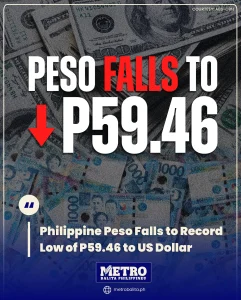
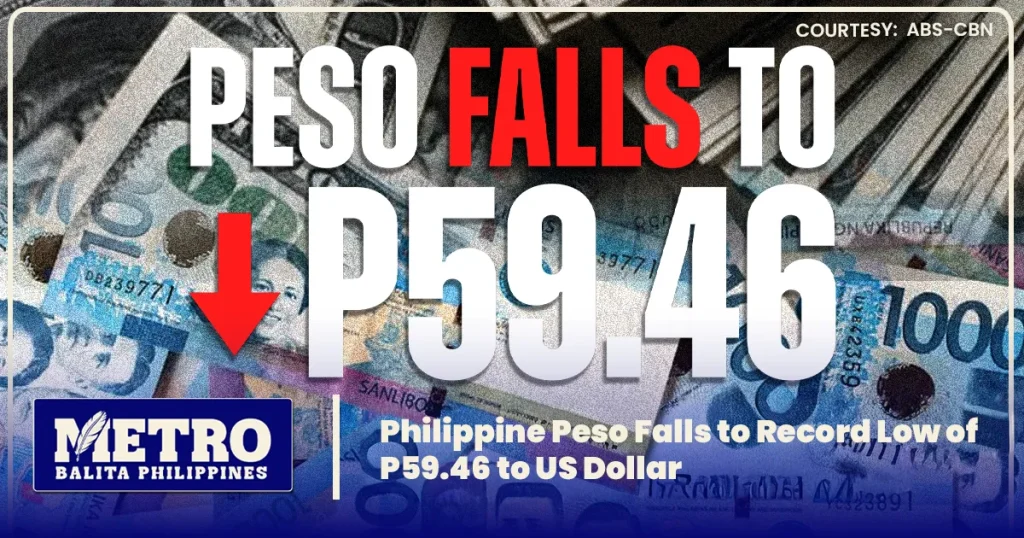
The philippine peso dropped to a new record low of ₱59.46 against the US dollar. This is one of the weakest levels ever recorded for the local currency. The peso’s fall reflects both global and local economic pressures that continue to affect the Philippine economy.
Many experts say this decline did not happen overnight. It is the result of strong demand for the US dollar worldwide, higher interest rates in the United States, and concerns about inflation and imports in the Philippines. These factors combined pushed the peso lower during trading.
Why the Philippine Peso Became Weaker
One major reason for the peso’s fall is the strong US dollar. Investors around the world prefer holding dollars during uncertain times because it is seen as a safe currency. When more investors buy dollars, other currencies like the philippine peso usually weaken.
Higher interest rates in the United States also play a big role. When US interest rates are high, investors move their money to US banks and assets to earn better returns. This causes money to flow out of developing countries, putting pressure on their currencies.
Locally, rising import costs and concerns about inflation added to the peso’s weakness. Since the Philippines imports fuel, food, and other goods, more dollars are needed to pay for these items, increasing demand for foreign currency.
Weaker Peso Helps BPO Sector and OFW Families
Economist Aris Dacanay said the weaker philippine peso is not likely to cause higher inflation. Instead, it may help the country’s business process outsourcing sector. He explained that Philippine BPO companies have been losing clients to India because India’s currency weakened faster. With the peso now depreciating, Philippine BPO services become more competitive in global markets.
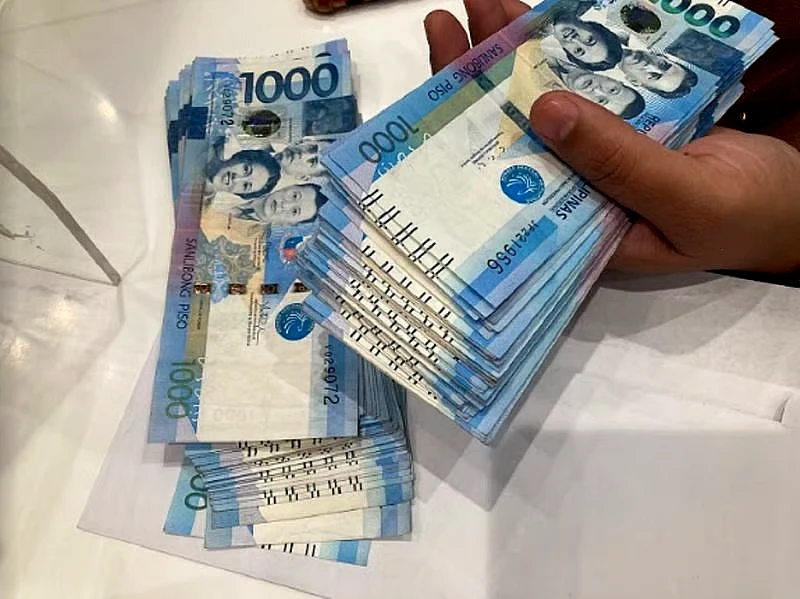
The weaker peso also benefits overseas Filipino workers and their families. Dollar remittances convert to more pesos, giving families extra support for daily expenses. This is especially helpful for OFW families paying school tuition, as the academic year begins in mid-January.
Peso Seen Staying Below ₱60 per Dollar
Despite recent weakness, Dacanay does not expect the philippine peso to go beyond ₱60 per US dollar. He said the country’s current account may improve this year as exports increase and imports slow down. The global demand for electronics, driven by the growing AI industry, is expected to support Philippine exports.
At the same time, slower infrastructure spending may reduce imports of construction materials and vehicles. With exports rising, imports falling, and household spending stabilizing, these factors may help support the peso near the ₱60 level.
What the Government and Central Bank Are Doing
The Bangko Sentral ng Pilipinas continues to monitor the peso closely. The central bank has said it is ready to act if the peso becomes too unstable. Its goal is not to control the exchange rate but to keep the market orderly.
Officials have also pointed out that the country still has strong foreign reserves. These reserves help protect the economy from sudden shocks and support the peso during difficult periods.
The government has assured the public that it is watching inflation and currency movements carefully to prevent further economic stress.
What to Expect in the Coming Months
Experts believe the philippine peso may stay weak in the short term, especially if the US dollar remains strong. Global events, interest rate decisions, and inflation data will continue to influence currency movements.
If global conditions improve or US interest rates ease, the peso may recover slowly. However, as long as uncertainty remains, the peso could continue to face pressure.
Conclusion
The fall of the philippine peso to ₱59.46 against the US dollar shows how global economic conditions can affect local markets. While the weak peso brings challenges such as higher prices and reduced buying power, it also highlights the need for careful economic planning and stability.
Filipinos are encouraged to stay informed as the situation develops and as authorities work to manage the effects of currency changes. Metro Balita Ph