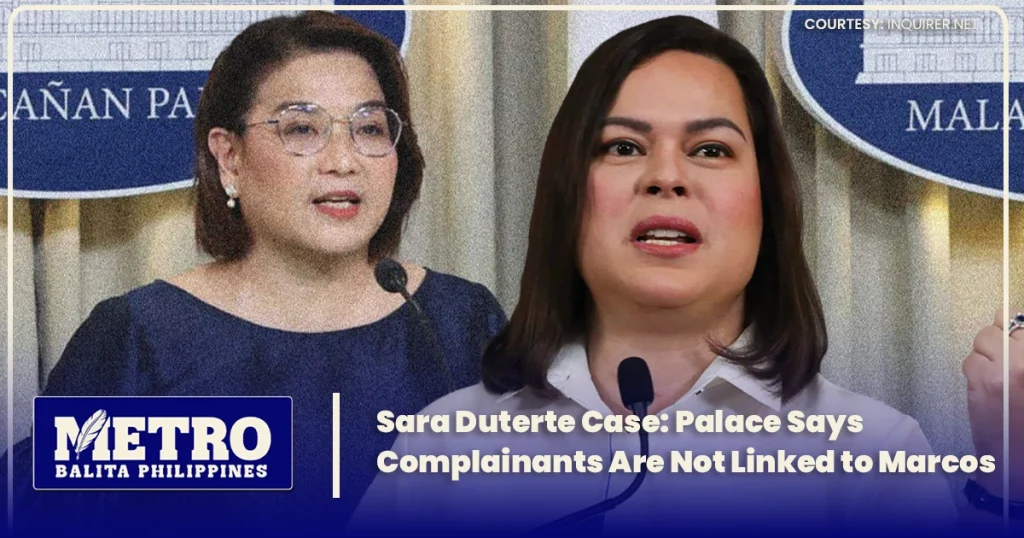
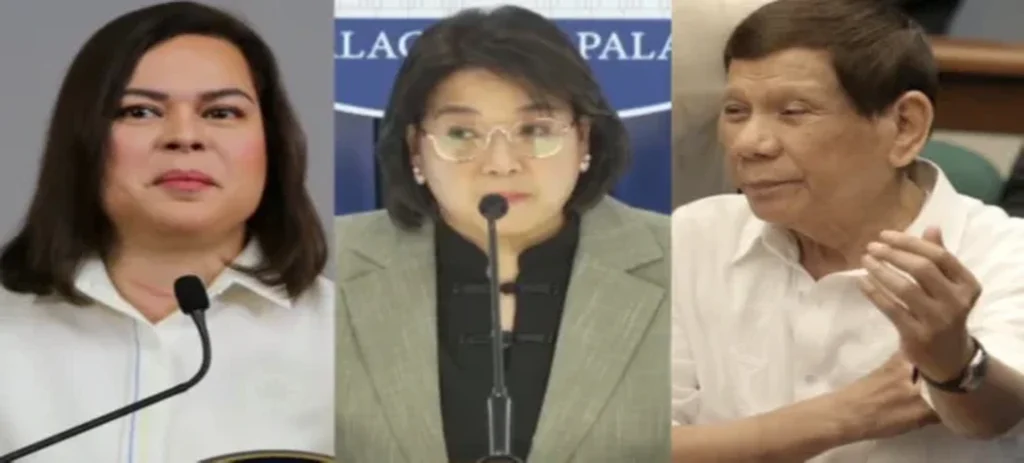
Malacañang Palace has firmly denied claims that the individuals who filed complaints against Vice President Sara Duterte are connected to President Ferdinand “Bongbong” Marcos Jr. or any political group associated with him. The clarification comes amid growing speculation that the Sara duterte case is politically motivated, particularly following the widening rift between key political figures who once shared a common electoral platform.
According to Palace officials, the complainants acted independently and were not encouraged, supported, or influenced by the Marcos administration. The Palace emphasized that the legal actions against Vice President Duterte were initiated by private individuals and groups exercising their constitutional right to seek accountability through lawful means.
The statement was issued in response to public discussions suggesting that the complaints were part of a broader political strategy to weaken Duterte’s position. Palace representatives said such claims divert attention away from the actual legal issues raised in the case and risk misleading the public about the nature of the complaints.
The Sara duterte case has drawn national attention due to its political implications and the high office involved. While the Palace acknowledged the public’s interest in understanding the background of the complainants, it stressed that political affiliation should not overshadow the legal process.
Key Clarifications from Malacañang
To address growing speculation, the Palace laid out several points to clarify its position on the controversy:
- The complainants are not members of President Marcos Jr.’s political party or inner circle
- There is no evidence of coordination between Malacañang and the individuals who filed the complaints
- The President did not instruct, encourage, or endorse the filing of any case against Vice President Duterte
- The administration respects the independence of the legal and constitutional processes involved
Palace officials reiterated that the role of the executive branch is not to interfere but to allow institutions to function as intended under the law. They added that accountability mechanisms exist precisely to handle complaints against public officials, regardless of rank or political alliance.
The Palace also warned against framing the Sara duterte case as a conflict between political families, saying this oversimplifies a complex legal matter and fuels unnecessary division.
Background of the Sara Duterte Case
The Sara duterte case refers to complaints filed against Vice President Duterte that question the use of confidential funds during her time in government. These allegations have triggered debates on transparency, public trust, and the proper handling of state resources.
Vice President Duterte has repeatedly denied wrongdoing and has described the complaints as baseless. Her allies have raised concerns about timing and motive, suggesting that political considerations may be influencing public perception of the case.
Despite these claims, legal experts have pointed out that filing a complaint does not automatically equate to guilt. They stress that due process must be followed and that the burden of proof lies with the complainants. The Palace echoed this view, stating that all parties involved deserve fairness and respect under the law.
The controversy has also highlighted broader issues withinPhilippine politics, including the role of public funds, transparency requirements for high-ranking officials, and the limits of political loyalty once officials assume office.
Why the Palace Statement Matters
The Palace’s clarification carries weight because it seeks to separate governance from partisan politics. By distancing itself from the complainants, Malacañang aims to reinforce the idea that the Sara duterte case should be judged based on facts and legal merit rather than political narratives.
Observers note that public confidence in institutions depends largely on perceptions of independence and fairness. When accusations of political interference arise, they can weaken trust in the justice system. The Palace’s response appears designed to counter such concerns and maintain institutional credibility.
Political analysts also point out that the administration’s stance could influence how future accountability cases are perceived. A clear separation between the executive and complainants may help prevent similar controversies from being dismissed outright as political retaliation.
At the same time, the Palace acknowledged that public scrutiny is natural, especially when disputes involve high-profile leaders. It urged the public to rely on verified information and allow the legal process to unfold without premature conclusions.
Conclusion
As the Sara duterte case continues to unfold, Malacañang Palace has made its position clear: the complainants are not linked to the Marcos camp, and the administration is not involved in pursuing the case. The Palace insists that accountability should remain a matter for the appropriate legal and constitutional bodies, free from political assumptions.
Whether the case progresses or is dismissed will ultimately depend on evidence and legal evaluation, not on political affiliations. For now, the Palace’s statement serves as a reminder that in a democratic system, complaints against public officials can arise independently, even among former allies. Metro Balita Ph